






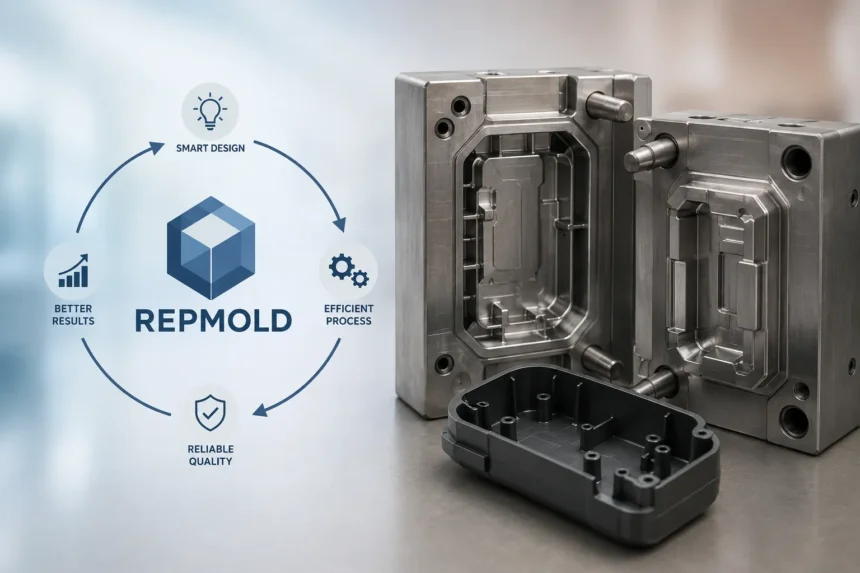
Factories waste thousands of hours every year redoing molds from scratch. Designs change. Tolerances shift. Materials behave differently under pressure. And every time a manufacturer has to start over, costs climb, and timelines stretch.
- What Is Repmold?
- The Evolution of Molding Technology
- How Repmold Works
- Core Technologies Behind Repmold
- Key Features of Repmold
- Repmold vs. Traditional Methods
- Major Applications of Repmold Across Industries
- Core Benefits of Repmold
- Challenges and Limitations of Repmold
- Repmold and Industry 4.0: AI, Automation, and Smart Manufacturing
- Environmental and Sustainability Impact
- How Small Businesses Can Benefit from Repmold
- Implementing Repmold in Business Operations
- Addressing Misconceptions About Repmold
- The Early Detection Advantage (Mold Remediation Context)
- Future of Repmold Technology
- Conclusion
- FAQs
Repmold solves a big part of that problem. Whether you’re looking at it as a mold-making process, a remediation system, or a smarter way to replicate existing designs, the core idea stays the same: improve what already exists rather than rebuild it from scratch.
This guide breaks down exactly what it is, how it works across industries, and what businesses need to know before adopting it.
What Is Repmold?
The word itself gives you a clue. “Rep” comes from replicate or repeat. “Mold” refers to the shaped form used to produce consistent parts or structures. Put them together and you get a process centered on accurately reproducing, refining, and improving molds — without starting from scratch every time.


In manufacturing, it functions as an advanced mold-making technology that creates exact copies of components with speed and precision. Instead of weeks of design cycles, teams can produce validated molds in a fraction of the time.
In building and property contexts, it refers to a modern mold remediation system — one that detects, removes, and prevents mold growth rather than simply wiping surfaces clean.
Both definitions share the same core logic: address root causes, not just symptoms. Improve the existing system. Make results more consistent and durable.
The Evolution of Molding Technology
Traditional molding methods like injection molding and die casting were revolutionary when they emerged. But they came with significant drawbacks — expensive tooling, long setup times, and almost no flexibility once production began.
If a design changed mid-production, manufacturers had to scrap the tooling and start over. That process burned time, money, and materials. Human error crept in at every handoff.
Digital design tools changed the equation. As CAD software matured alongside 3D printing and CNC machining, engineers gained the ability to design, test, and refine molds digitally before a single piece of physical tooling was created. Automated replication systems then handled the reproduction process with minimal deviation.
That shift from handcraft to digital-driven replication is what laid the groundwork for what most industries now call this technology.
How Repmold Works
The process follows a logical sequence that prioritizes accuracy at every stage.
Design and Material Preparation
Everything starts with a precise digital model. Engineers use simulation software to test stress points, cooling systems, and material flow patterns before committing to physical production. Material selection — metals, resins, or composite polymers — depends on the product’s heat resistance, flexibility, and durability requirements.
Getting this stage right prevents expensive errors from multiplying across thousands of replicated parts.
From Prototype to Production
Once the digital design passes internal validation, a prototype mold is produced — typically through 3D printing or CNC machining. This is where teams test real-world performance without committing to full-scale tooling.
If the prototype passes inspection, automated replication systems take over. Each subsequent mold mirrors the original design with tight tolerances. Lead times drop significantly. Batch consistency becomes reliable rather than approximate.
Mold Detection and Assessment (Remediation Angle)
In the building context, the first step is identifying exactly where mold exists and how far it has spread. Detection tools include moisture meters, infrared cameras, air quality testing equipment, and surface sampling for laboratory analysis. These tools locate mold in hidden areas — behind walls, under flooring, inside HVAC systems — that visual inspection alone would miss.
Containment, Removal, and Restoration
Once the assessment is complete, the affected area gets isolated. Plastic barriers and negative air pressure systems prevent spores from spreading to clean spaces. HEPA vacuum systems and antimicrobial treatments target mold colonies at a deeper level than standard surface cleaning.
After removal, the restoration phase begins — replacing damaged drywall, sealing surfaces, repairing flooring, and rebuilding any compromised structures. The goal is not just to remove the mold but to return the building to a fully functional, safe condition.
Core Technologies Behind Repmold
Several technologies make the whole system work:
- CAD software — Enables precise mold dimensions and complex geometries that feed directly into production
- CNC machining — Produces prototype molds with tight tolerances from digital files
- Automated replication systems — Reproduce identical molds at scale with minimal human intervention
- Moisture control systems — In remediation contexts, dehumidifiers and improved ventilation eliminate the root cause of recurring mold
- Rapid prototyping — Compresses the design-test-refine cycle from weeks to days
None of these works in isolation. The strength of this approach is that it combines them into a coherent, repeatable workflow.
Key Features of Repmold
| Feature | What It Means in Practice |
| Speed | Shorter production lead times, faster time-to-market |
| Precision | Dimensional accuracy across every mold produced |
| Scalability | Move from a single prototype to large batches without quality loss |
| Flexibility | Modify designs digitally without scrapping physical tooling |
| Long-term prevention | Addresses root causes, not just visible symptoms |
| Eco-friendly treatments | Reduces scrap, supports sustainable manufacturing goals |
Repmold vs. Traditional Methods
The clearest way to understand the advantage is through direct comparison.
| Factor | This Approach | Traditional Method |
| Starting point | Existing design | New design each time |
| Production speed | Fast | Slow |
| Cost over time | Lower | Higher |
| Design flexibility | High | Limited |
| Material waste | Low | Significant |
| Focus | Improvement and replication | Replacement |
Traditional methods demand that every design change trigger a full tooling restart. Digital replication systems allow on-demand manufacturing — update the model, rerun the process, move forward. That difference compounds over time, especially for businesses managing frequent product updates.
Major Applications of Repmold Across Industries
Manufacturing and Plastics
High-volume production benefits most from consistent mold replication. Factories use these systems to produce large quantities of parts with low defect rates. When a mold begins to wear, it gets replicated digitally rather than rebuilt manually.
Automotive and Aerospace
Both industries demand precision that leaves almost no margin for error. Lightweight components for aerospace, engine parts for automotive — these require tight tolerances across thousands of identical units. This technology shortens development cycles and improves reliability from prototype through mass production.
Medical and Healthcare
Patient safety depends on part accuracy. Surgical tools, implant components, and diagnostic device housings all require manufacturing consistency that cannot tolerate variation. In healthcare facilities, the remediation angle also applies: hospitals and clinics maintain strict environmental controls where mold detection and removal are non-negotiable.
Consumer Electronics and Product Design
Intricate casings, connectors, and internal housings for devices are produced faster with replication-based molding. Design teams can test multiple iterations quickly, which accelerates the feedback loop between engineering and production.
Residential and Commercial Buildings (Remediation)
Homeowners dealing with water damage or persistent humidity increasingly rely on professional mold remediation systems. Offices, hotels, and retail spaces face similar challenges. Mold-free properties hold higher value for buyers and tenants — making early, thorough remediation a financially sound decision.
Core Benefits of Repmold
The practical advantages stack up across several dimensions:
- Faster prototyping cuts weeks off the design cycle
- Reduced production costs come from fewer wasted materials and lower labor requirements
- High precision means fewer defects and less post-production rework
- Adaptability lets manufacturers respond to design updates without retooling from scratch
- Indoor air quality improvement results from proper mold remediation, reducing respiratory risks for building occupants
- Structural preservation prevents the kind of mold damage that weakens walls, flooring, and insulation over time
Challenges and Limitations of Repmold
No system is without friction. The initial investment in digital infrastructure — CAD software, automated machinery, skilled operators — can be steep for teams transitioning from traditional manufacturing.
Material compatibility is another real constraint. Not every material works well within automated replication systems. Teams need to evaluate their specific application before committing.
The learning curve is steeper than it looks on paper. Workers accustomed to manual tooling need time and training to operate digital design workflows effectively. Resistance to change is common in established production environments, and that resistance can slow adoption even when the technology makes clear financial sense.
Regular updates and continuous improvement are also required. This isn’t a set-it-and-forget-it system.
Repmold and Industry 4.0: AI, Automation, and Smart Manufacturing
This is where the technology starts to get genuinely interesting.
Quality Control in Repmold Production
Modern systems using this method integrate sensors and analytics that monitor every variable in real time — pressure, temperature, material flow. When any reading falls outside set parameters, the system triggers an alert immediately. Automated inspections and 3D scanning verify that each part meets exact specifications before it moves to the next stage.
The Role of Data and Cloud Connectivity
Cloud-based platforms allow manufacturers to store design files, track production metrics, and share updates across teams in different locations. AI insights drawn from historical production data help refine mold geometry, predict wear patterns, and flag weak points before they become failures. Over time, each production cycle produces better data, which makes the next cycle smarter.
Environmental and Sustainability Impact
Manufacturing waste is a measurable problem, and this approach directly reduces it. Digital replication eliminates the need for multiple physical prototypes. Recyclable and biodegradable materials increasingly replace conventional options. Energy consumption drops when automated systems replace labor-intensive manual processes.
In the remediation context, eco-friendly cleaning solutions and moisture control methods prevent mold from returning — reducing the need for repeated chemical treatments over time.
How Small Businesses Can Benefit from Repmold
Large corporations don’t have a monopoly on this technology. Affordable desktop CNC machines and accessible 3D printing options have lowered the entry barrier significantly. Small and medium-sized businesses can now prototype products, run small batches, and iterate on designs without heavy capital investment.
Government grants and industry partnerships in several regions are also helping smaller manufacturers modernize. Turnkey solutions — where the setup, training, and support come bundled together — make the transition more manageable for teams without dedicated engineering departments.
Implementing Repmold in Business Operations
Tips to Maximize Repmold Results
- Use high-quality materials from the start — stronger molds produce more consistent parts
- Keep molds clean and properly lubricated to extend their operational life
- Review each production run analytically; the data reveals improvement opportunities that visual inspection misses
- Prioritize energy-efficient machines when upgrading equipment
Common Mistakes to Avoid
Skipping the prototype validation phase is the most costly mistake. Errors that go undetected at the prototype stage multiply across every replicated unit. Teams also underestimate the importance of real-time analytics — without monitoring, even automated systems drift over time.
Cost Considerations and ROI
Setup costs run higher than traditional approaches upfront. But the return on investment becomes visible quickly through reduced waste, faster production cycles, and lower rework costs. Businesses that track their cost-per-unit before and after adoption typically see meaningful savings within the first year of full implementation.
Addressing Misconceptions About Repmold
A few persistent myths slow adoption unnecessarily.
The first is that it only works for large industrial operations. It doesn’t — small businesses use scaled versions of the same technology effectively. The second is that it’s slower than traditional methods. In practice, digital-driven replication is dramatically faster once the initial setup is complete. The third is that it’s too expensive. When you factor in reduced labor, lower material waste, and fewer production errors, the total cost of ownership is typically lower than conventional tooling over a two-to-three year period.
The Early Detection Advantage (Mold Remediation Context)
In building management, early detection makes an enormous difference. Small mold patches that go untreated become major infestations within weeks under the right humidity conditions.
Common warning signs include musty odors, discolored walls or ceilings, peeling paint, and persistent dampness. Increased allergy symptoms among occupants are another reliable indicator. When these signs appear, professional inspection and remediation should happen promptly — not after the damage becomes structural.
Future of Repmold Technology
The next decade will bring significant advances.
Workforce and Education for Repmold Growth
Universities and technical institutions are beginning to offer specialized courses in replication molding, automation, and digital manufacturing. The combination of engineering skills, design thinking, and digital literacy will define the next generation of manufacturing professionals. Ongoing education — not just initial training — keeps teams competitive as the technology evolves.
Economic Impact and Global Expansion
On a macro level, this system supports local manufacturing viability. Companies no longer need large overseas facilities to compete on quality. Smaller local operations can produce world-class components, reducing logistics costs and emissions while creating skilled jobs in their communities. Industrial growth supported by this technology tends to be more resilient because it isn’t dependent on long, fragile supply chains.
Conclusion
Repmold represents a practical, proven shift in how manufacturing and building management handle quality, consistency, and efficiency. It reduces waste, shortens production timelines, lowers costs over time, and creates more durable outcomes — whether that means a precision automotive component or a mold-free commercial building.
Early adopters across industries are already seeing the advantages. As automation, AI integration, and cloud connectivity continue to mature, the gap between businesses using these systems and those still relying on traditional methods will widen. The technology is accessible, the ROI is measurable, and the direction of the industry is clear.
FAQs
FAQ 1: What is Repmold and what does it mean?
It combines “rep” (replicate or repeat) and “mold” (shape or form). The concept refers to a process of improving and reproducing existing designs or systems rather than starting from scratch — making production faster, more consistent, and more cost-effective.
FAQ 2: What materials can be used with this technology?
The process supports plastics, metals, composites, and resins. The right material depends on the project’s specific requirements — including heat resistance, flexibility, and load-bearing needs. A materials engineer can help match the right choice to the application.
FAQ 3: How does it differ from traditional molding and 3D printing?
Traditional molding requires new physical tooling for every design change. 3D printing creates objects layer by layer from digital files but can be slower for high-volume production. This method combines digital precision with faster replication — producing consistent results at scale more efficiently than either approach alone.
FAQ 4: Is it only useful for prototypes or full production runs?
Both. It handles rapid prototyping effectively, but its real strength shows in full-scale production runs where consistency across thousands of identical parts matters most.
FAQ 5: What industries benefit most from this system?
Automotive, aerospace, medical devices, consumer electronics, and manufacturing see the largest gains. Building management and remediation services also benefit significantly from the mold detection and prevention side of the technology.
FAQ 6: Can small businesses afford this technology?
Yes. Affordable desktop CNC machines and 3D printing options have reduced the barrier to entry. Government grants and industry partnerships in many regions provide additional support for smaller manufacturers looking to modernize.
FAQ 7: What are the main challenges of adoption?
Initial investment, training requirements, and material compatibility are the three biggest hurdles. Gradual adoption — starting with specific projects before scaling — helps teams manage the transition without disrupting existing operations.
FAQ 8: How does it support sustainability and environmental goals?
It reduces material waste through precise digital replication, supports the use of recyclable and biodegradable materials, and lowers energy consumption through automated processes. In remediation contexts, eco-friendly cleaning solutions reduce chemical use while delivering more durable results.