


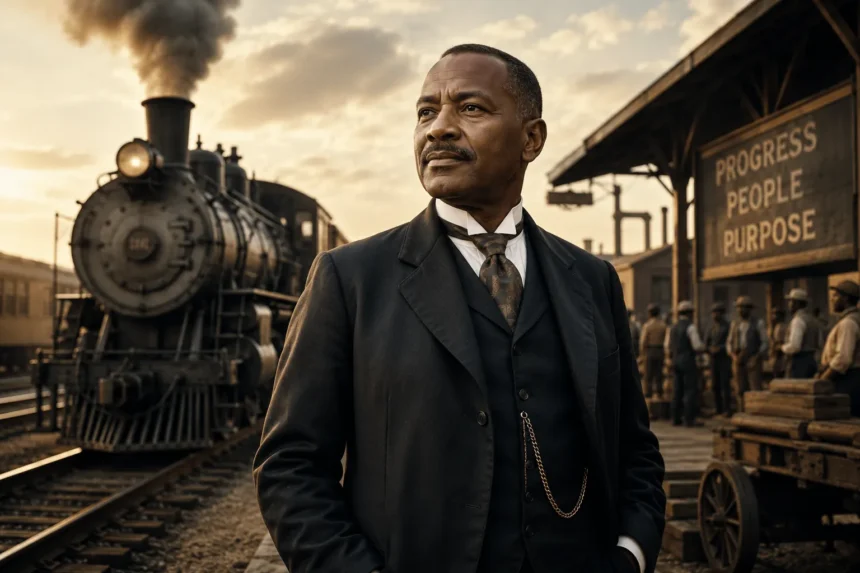
Claude Edward Elkins Jr. is an American railroad executive serving as Executive Vice President and Chief Commercial Officer at Norfolk Southern Corporation. Known professionally as Ed Elkins, he oversees commercial strategy, freight operations, and customer logistics for one of the largest freight rail networks in North America. His career represents one of the clearest examples of ground-up advancement in the U.S. transportation industry.
- Early Life and Upbringing in Southwest Virginia
- Education and Academic Foundation
- Early Railroad Career — Learning the Industry from the Ground Up
- Transition to Marketing and Commercial Leadership
- Executive Leadership at Norfolk Southern Corporation
- Leadership Style and Operational Approach
- Net Worth and Executive Compensation
- Role in Rail Industry Transformation and Legacy
- Board Memberships and Community Leadership
- Conclusion
- FAQs
Quick Bio at a Glance
| Category | Details |
| Full Name | Claude Edward Elkins Jr. |
| Known As | Ed Elkins |
| Date of Birth | June 21, 1965 |
| Age | 60 |
| Birthplace | Southwest Virginia |
| Military Service | United States Marine Corps (Veteran) |
| Education | B.A. English, University of Virginia’s College at Wise; MBA Port and Maritime Economics, Old Dominion University |
| Current Role | Executive Vice President & Chief Commercial Officer, Norfolk Southern Corporation |
| Promoted to CCO | March 2025 |
| Annual Compensation | $3.3M – $3.9M |
| Estimated Net Worth | $10M – $20M |
| Children | Two Daughters |
| Board Affiliations | Georgia Chamber of Commerce (2025 Chair), National Association of Manufacturers, TTX Company, East Lake Foundation |
Early Life and Upbringing in Southwest Virginia
Growing up in Southwest Virginia meant daily exposure to coal mining, active rail lines, and industrial movement. That environment shaped Ed Elkins’s understanding of how transportation systems function before he ever held a professional title.
Influence of Family and Community
The Appalachian community he grew up in valued honesty, reliability, and a consistent work ethic above most other things. Success was measured by integrity and contribution — not status. These values stayed embedded in his professional character throughout a 35-year career.
Military Service in the United States Marine Corps
Before entering the railroad industry, Ed Elkins served in the United States Marine Corps. The Corps is structured around a chain of command, operational readiness, and high-pressure decision-making — all directly applicable to managing freight rail systems at scale.


His military background developed mental toughness, teamwork under stress, and accountability — qualities that later defined his leadership approach at every level of Norfolk Southern.
Education and Academic Foundation
Ed Elkins holds a Bachelor of Arts in English from the University of Virginia’s College at Wise. The degree built his communication, critical thinking, and analytical skills — capabilities that proved directly useful in marketing leadership and executive communication.



He followed that with an MBA concentrating in Port and Maritime Economics from Old Dominion University. This graduate work gave him a rigorous framework for understanding logistics, transportation economics, intermodal transportation, and the economic frameworks connecting rail and global shipping industries.
He also completed executive leadership programs at Harvard Business School and the University of Tennessee Supply Chain Institute — institutions that deepened his strategic perspective on supply chain management and commercial planning.
His academic path is unusual by railroad executive standards, and that is part of what makes it effective. A liberal arts foundation combined with applied logistics education gave him both analytical range and operational focus.
Early Railroad Career — Learning the Industry from the Ground Up
Ed Elkins joined Norfolk Southern in 1988 as a road brakeman — a physically demanding, entry-level role that involved coupling and uncoupling rail cars, monitoring safety protocols, and supporting train crews across active lines.
He then moved into roles as a conductor, locomotive engineer, and relief yardmaster. Each position added a different layer of operational understanding: conductors manage crew coordination and train movement; engineers operate locomotives over long distances; yardmasters oversee complex rail yard operations and crew scheduling.
Few executives at the Chief Commercial Officer level have spent time in all four of these roles. That depth of frontline rail worker experience is not common, and it directly informs how Ed Elkins makes decisions — with a grounded understanding of what freight movement operations actually require at the ground level.
Transition to Marketing and Commercial Leadership
After nearly two decades in rail operations, Ed Elkins moved into intermodal marketing — coordinating freight solutions that connect rail, trucking, and maritime transport. The shift required translating operational knowledge into customer relationships, market positioning, and revenue growth.
He expanded into Automotive Logistics and Industrial Products, overseeing market sectors with distinct client demands, pricing structures, and service expectations. This phase of his career built the commercial influence and long-term business relationship skills that executive leadership requires.
Promotions and Executive Progress
His advancement through commercial roles followed a clear trajectory:
- 2016 — Group Vice President of Chemicals Marketing
- 2018 — Vice President of Industrial Products
- 2021 — Chief Marketing Officer
- March 2025 — Executive Vice President and Chief Commercial Officer
Each promotion reflected expanded responsibility rather than lateral movement. By the time he reached the CCO role, he had managed chemicals, industrial, and automotive segments — covering the major commercial categories of a Fortune 500 railroad.
Executive Leadership at Norfolk Southern Corporation
As Executive Vice President and Chief Commercial Officer, Ed Elkins oversees a broad set of divisions: Intermodal, Automotive, Industrial Products, Real Estate, Industrial Development, Short Line Marketing, Field Sales, and Customer Logistics.
His responsibilities include pricing strategy, operational excellence, and customer-centric solutions that align freight capacity with market demand. Under his leadership, Norfolk Southern has pursued sustainable practices and digital improvements to transportation network efficiency — balancing long-term strategic growth with day-to-day freight reliability.
The scope of this role means he is responsible for billions in freight revenue, coordinating across multiple industries that depend on consistent, safe rail transportation.
Leadership Style and Operational Approach
Ed Elkins leads with practical authority rather than distance. His years as a frontline rail worker mean he understands the challenges teams face at the operational level — and that understanding shapes how he communicates, delegates, and makes decisions.
Key characteristics of his approach include:
- Empathy with frontline workers — grounded in personal experience, not assumption
- Data-driven decision-making — commercial strategy backed by freight performance metrics
- Customer-focused logistics — aligning service delivery with actual client requirements
- Accountability and teamwork — a direct carryover from the United States Marine Corps structure
- Safety culture — consistently prioritized across rail systems and operational processes
This combination of operational knowledge and strategic foresight is what separates executives who grew through a company from those who entered at the top.
Net Worth and Executive Compensation
Ed Elkins’s estimated net worth falls between $10 million and $20 million, built primarily through long-term employment at a single corporation rather than through high-frequency job changes or speculative investment.
His annual compensation has ranged from $3.3 million to $3.9 million in recent years, combining base salary, performance bonuses, and stock incentives tied to shareholder value and freight network outcomes. Long-term incentive plans and compounding equity over 35 years account for the bulk of his accumulated wealth.
Compared to transportation executives managing freight networks of similar scale, his pay aligns with market norms for the scope of responsibility involved.
Role in Rail Industry Transformation and Legacy
Ed Elkins has been part of Norfolk Southern’s shift toward digital transformation in logistics systems, freight network optimization, and modernized industrial supply chain networks. These aren’t abstract initiatives — they affect delivery speed, cargo handling efficiency, and the coordination of rail-based commerce across the American rail system.
His work supports transportation infrastructure development at a national scale. Rail freight expansion, intermodal freight growth, and improvements to operational safety standards are areas where his leadership has contributed measurable change.
Beyond Norfolk Southern, his legacy extends to workforce development initiatives and the broader transportation sector innovation that keeps freight rail competitive against trucking and air cargo alternatives.
Board Memberships and Community Leadership
Ed Elkins serves as 2025 Chair of the Georgia Chamber of Commerce — a role that positions him as a voice for business development and economic growth beyond the railroad industry. He also holds board affiliations with the East Lake Foundation, National Association of Manufacturers, and TTX Company.
These memberships reflect both industry influence and civic commitment. His involvement in workforce development through these organizations aligns with his belief that strong rail systems require equally strong pipelines of skilled workers.
Conclusion
Ed Elkins built his career by staying in one industry long enough to understand every layer of it — from coupling rail cars in 1988 to setting commercial strategy for a Fortune 500 railroad today. His path offers a practical model: operational knowledge compounds over time, and formal education accelerates the transition from frontline worker to executive. For anyone researching Claude Edward Elkins Jr., his career demonstrates that depth of experience, not just title accumulation, drives lasting influence in complex industries.
FAQs
Who is Claude Edward Elkins Jr., and what is he known for?
Claude Edward Elkins Jr., also known as Ed Elkins, is a railroad executive and Executive Vice President and Chief Commercial Officer at Norfolk Southern Corporation, recognized for rising from a frontline brakeman to a senior freight transportation leader over 35 years.
When did Ed Elkins join Norfolk Southern, and in what role?
He joined Norfolk Southern in 1988 as a road brakeman — an entry-level frontline rail worker position — after completing his service in the United States Marine Corps.
What is Ed Elkins’s educational background?
He earned a B.A. in English from the University of Virginia’s College at Wise and an MBA in Port and Maritime Economics from Old Dominion University, with additional executive programs at Harvard Business School and the University of Tennessee Supply Chain Institute.
Did Claude Edward Elkins Jr. serve in the military?
Yes. He is a United States Marine Corps veteran. His military service built the discipline, operational readiness, and leadership under pressure that shaped his long career in rail operations and logistics.
What is Ed Elkins’s estimated net worth?
His net worth is estimated between $10 million and $20 million, accumulated through 35 years of executive compensation, long-term equity participation, and performance bonuses tied to Norfolk Southern’s freight performance.
What divisions does Ed Elkins oversee as Chief Commercial Officer?
He oversees Intermodal, Automotive, Industrial Products, Real Estate, Industrial Development, Short Line Marketing, Field Sales, and Customer Logistics — covering Norfolk Southern’s full commercial portfolio.
What boards and organizations is Ed Elkins affiliated with?
He serves as 2025 Chair of the Georgia Chamber of Commerce and holds board positions with the East Lake Foundation, National Association of Manufacturers, and TTX Company.
Why is Ed Elkins’s career considered an inspiring leadership model?
His path from road brakeman to Executive Vice President across 35 years at one company — supported by military discipline, formal education, and progressive commercial roles — demonstrates how operational depth converts into executive authority in complex industries.