




Jude Bellingham doesn’t just dominate midfields — he sets grooming trends. The Jude Bellingham haircut has become one of the most requested styles in barbershops across the UK, Europe, and beyond. Fans walk in with his photo saved on their phones. Barbers call it by name. Some even call it the bellicut.
- What Is the Jude Bellingham Haircut?
- Evolution of Jude Bellingham’s Hairstyles Through the Years
- All Jude Bellingham Haircut Variations
- Why the Jude Bellingham Haircut Is So Popular
- Does the Jude Bellingham Haircut Suit Your Face Shape?
- Preparing for the Haircut
- Step-by-Step Barber Guide to Achieve the Look
- Hair Type Considerations
- How to Achieve the Jude Bellingham Haircut at Home
- How to Maintain the Jude Bellingham Haircut
- Common Mistakes to Avoid
- How It Compares to Other Footballers’ Haircuts
- Professional and Social Suitability
- Conclusion
- FAQs
This guide breaks down everything: what the cut actually is, how it evolved, which variation suits your hair type, and exactly what to tell your barber when you sit in the chair.
What Is the Jude Bellingham Haircut?
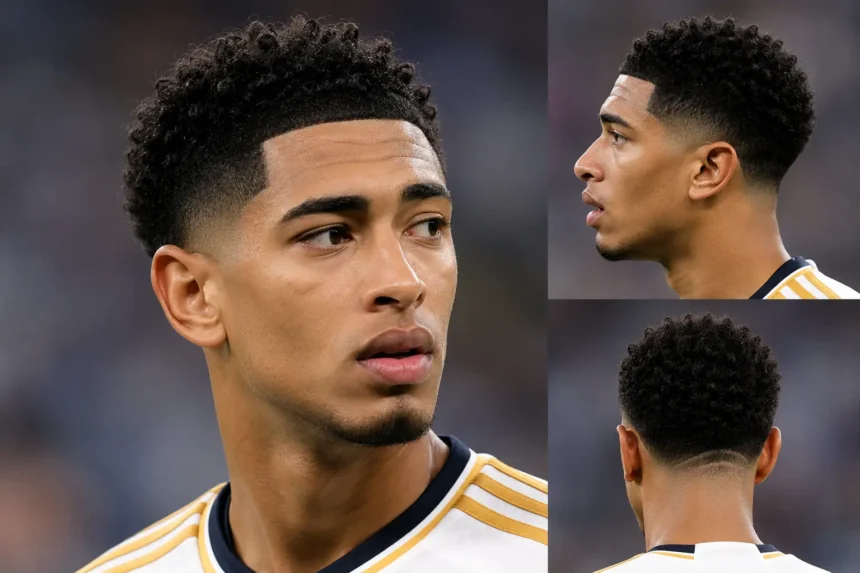
At its core, this is a curly taper fade — sometimes described as a textured crop fade. The top carries natural volume and curl definition, while the sides blend down into a clean, gradual fade. The hairline is sharp and precise, which gives the whole look its polished finish.
Most people know it for three things: the natural curls on top, the low to mid taper on the sides, and the shape-up around the hairline. It’s bold without being aggressive. Sleek without looking overdone. That balance is exactly why it works.
Key Features of the Haircut
The top typically sits at one to three inches in length. Barbers use point cutting — cutting vertically into the hair rather than straight across — to create soft texture and movement. This prevents that flat, helmet-like look you get from blunt cutting.
Key structural details:
- Natural curl or wave texture left on top for volume and separation
- Taper fade on the sides and back (low or mid, depending on preference)
- Precision shape-up along the hairline — forehead, temples, and behind the ears
- Defined edges that frame the face without looking artificially sharp
- Seamless blend — no harsh lines between the top and the sides
Jude Bellingham Haircut Back View
The back of this haircut matters more than most people realize. From behind, the fade tapers down gradually toward the neckline. The neckline itself is kept rounded and natural — not squared off, which would look boxy and dated.
The back fade connects seamlessly to the sides, maintaining a consistent look from every angle. This is one reason the style photographs so well and holds up under camera scrutiny at matchday.
Evolution of Jude Bellingham’s Hairstyles Through the Years
Bellingham’s hair didn’t always look like this. In his early career, he wore simpler, shorter styles with minimal definition. During the Borussia Dortmund era, his hair began to grow out, and the texture started to show more clearly. The fade became more deliberate. The shape-up more refined.
By the time he moved to Real Madrid, the style had fully matured. The curly taper fade became his signature — consistently maintained, always sharp, never overdone. You can trace the arc from a basic short crop to one of the most replicated hairstyles in men’s grooming today.
All Jude Bellingham Haircut Variations
Bellingham doesn’t wear one fixed style. He adjusts based on the season, occasion, and grow-out phase. Here are the main variations fans and barbers have identified.
Mid Taper Fade
This is the most common version. The fade starts around the temple and blends cleanly into the crown. It creates a balanced, polished look with a visible transition from shorter sides to the textured top. Natural curls sit well in this version, and the contrast is strong enough to be stylish without being extreme.
Low Taper Fade
The conservative option. The fade starts closer to the ears and shortens gradually toward the neck. It’s subtle and clean — the closest thing to Bellingham’s original signature style. If you want the look without too much contrast, this is the variation to request.
Skin Fade
Less common, but Bellingham has worn it. The sides go down to the skin, which creates a sharper, more experimental look. Combined with a cropped top and defined curls, it’s a standout style — but it requires more frequent maintenance to stay sharp.
High Fade
Rarely seen on him, but it exists in his style history. The fade climbs higher toward the crown and pairs with the curly top for dramatic contrast. It’s not the typical Bellingham look, but it shows his willingness to experiment.
Why the Jude Bellingham Haircut Is So Popular
Part of the appeal is practical. This style complements nearly all hair types, fits both formal and casual environments, and requires minimal daily maintenance. Men who want to look put-together without spending twenty minutes in front of a mirror gravitate toward it.
The other part is cultural. Bellingham carries a disciplined, composed image — on the pitch and off it. His haircut reinforces that. It looks intentional without looking try-hard. Fans replicate it as a way of connecting with his personality, not just his appearance.
TikTok barber tutorials featuring this style have pulled millions of views. UK, US, and European barbershops report it as one of the top-requested cuts among men under 30. That’s not a coincidence — it’s the result of a style that genuinely performs well across contexts.
Does the Jude Bellingham Haircut Suit Your Face Shape?
One reason the cut travels so well is its proportional balance. The textured top adds height, while the clean sides keep the overall shape controlled.
| Face Shape | How the Haircut Works |
| Oval | Suits almost any variation — low or mid fade both work well |
| Round | Extra height on top helps lengthen the face, giving it a more streamlined and leaner look. |
| Square | Soft taper softens the jawline; avoid high fades that emphasise width |
| Heart-shaped | Gradual fade balances a wider forehead against a narrower jaw |
| Angular | Natural curl texture adds softness that contrasts with angular features |
If you’re unsure, start with the mid taper fade. It’s the most universally flattering variation.
Preparing for the Haircut
Walk into the barbershop prepared. The biggest mistake people make is sitting down without a reference photo and expecting the barber to read their mind.
Save a recent, clear photo of Bellingham — ideally one that shows the front, side, and back if possible. Then decide:
- How short do you want the sides? Low fade for subtle, mid fade for definition
- How much length on top? More length means more curl volume; less keeps it cropped
- How sharp do you want the edges? A natural shape-up suits most people better than an ultra-defined line-up
Bring your answers to the chair. Barbers work best with clear, specific direction.
Step-by-Step Barber Guide to Achieve the Look
Step 1 — Shampoo and Initial Comb
The barber starts with clean, damp hair. Wet hair lies closer to the head and shows its natural growth direction, which helps with accurate cutting. Combing through removes tangles and reveals where the hair naturally falls.
Step 2 — Establishing the Top Length
Using scissors, the barber works through the top section in layers. The front is left slightly longer than the back to create forward movement and natural lift. Point cutting throughout prevents a flat, blunt finish and builds in texture.
Step 3 — Creating the Fade
Clippers take over for the sides and back. The barber starts with a longer guard to remove bulk, then moves to shorter guards as they work down toward the hairline. Smooth transitions between guard sizes create the seamless blend — no lines, no jumps, no patches.
Step 4 — Detailing the Edges
A trimmer defines the hairline around the forehead, temples, ears, and neck. This shape-up is what makes the whole cut look intentional. Clean lines here pull the entire style together.
Step 5 — Final Texture and Style
Point cutting adds the last layer of texture to the top. If the hair is very thick, the barber may thin it slightly. A small amount of product applied at the end brings out the curl definition and shows how the style will look once it settles.
Hair Type Considerations
Afro or Curly Hair
This cut was built for Afro-textured and curly hair. A curl sponge used in a 360-degree motion shapes the top after cutting. Leave-in conditioner, curl cream, and natural oils — shea butter, coconut oil — keep curls soft and defined. Sleep on a silk pillowcase and wear a durag at night to preserve shape.
Wavy Hair
Wavy hair adapts well. A light pomade or texturising spray gives the waves definition without weighing them down. The mid fade pairs particularly well with wavy texture, as the contrast between the defined top and clean sides reads clearly.
Straight Hair
Straight hair can carry this cut, but it needs product support to hold volume on top. Hair mousse or a light volumising styling cream applied to damp hair creates lift. The texture won’t be as naturally pronounced, but the silhouette of the style transfers well.
Thick or Fine Hair
Thick hair needs thinning work during the cut — point cutting and scissor thinning reduce bulk without sacrificing length. Fine hair benefits from lightweight products and minimal thinning, keeping as much volume as possible.
How to Achieve the Jude Bellingham Haircut at Home
Daily styling for this cut is minimal. Start with slightly damp hair — not soaking wet. Scoop a small amount of product, warm it between your palms, then work it through the top with your fingers. Lift slightly as you go.
The goal is definition, not holding. You want the curls or texture to sit naturally, not be forced into a shape.
Best Products to Use
| Hair Type | Recommended Product | Why It Works |
| Curly / Afro | Curl cream or leave-in conditioner | Defines curls, adds moisture |
| Wavy | Light pomade or texturising spray | Holds wave pattern, natural finish |
| Straight | Hair mousse or volumising styling cream | Creates lift and texture |
| All types | Matte paste or texturising clay | Low shine, natural finish, light hold |
Avoid heavy pomades, shine gels, or anything that makes the hair stiff. The Bellingham look relies on movement.
How to Maintain the Jude Bellingham Haircut
| Maintenance Task | Frequency |
| Barber visit (fade touch-up) | Every 2–4 weeks |
| Full haircut refresh | Every 4–6 weeks |
| Deep moisturising treatment | Once a week |
| Edge detailing (home trimmer) | As needed between visits |
Overwashing breaks down the hair’s natural moisture, especially for Afro and curly textures. Wash your hair only two to three times per week. Use a gentle, SLS-free shampoo, or a co-wash product that cleans and conditions simultaneously.
Natural oils — argan oil, castor oil — applied to the ends at night keep strands healthy and prevent dryness.
Common Mistakes to Avoid
Most people who don’t get the look right make one of these errors:
- Requesting a high fade — it changes the character of the cut entirely and doesn’t match Bellingham’s actual style
- Asking for a skin fade — too harsh a contrast for this style; it undermines the soft, blended finish
- Requesting a hard line-up — a natural shape-up looks more refined; hard geometric lines look dated with this cut
- Over-styling at home — heavy product kills the movement that makes this haircut work; less is always more
How It Compares to Other Footballers’ Haircuts
Most footballers lean toward experimental or high-contrast styles — dramatic skin fades, bleached tips, elaborate designs. Bellingham’s cut goes the other direction. It’s restrained. Disciplined. The kind of haircut that ages well and translates into any context.
His barber Sheldon Edwards — who also works with Raheem Sterling and Jadon Sancho — brings a high level of precision to the shape-up and fade work. The cut isn’t achievable just anywhere. Bellingham reportedly visits New New Barbers and HD Cutz in the UK when he’s back from Madrid. Finding a barber with real fade experience makes a significant difference in the result.
Professional and Social Suitability
Few haircuts work in this many settings without any adjustment. The Bellingham cut moves from training ground to formal event to everyday life without looking out of place. It respects dress codes. It doesn’t distract. It projects a clean, composed image that complements rather than competes with how you’re dressed.
That versatility — athletic environments, professional settings, casual weekends — is a major reason the style has spread so far beyond football culture.
Conclusion
The Jude Bellingham haircut works because it’s built on fundamentals: a clean taper fade, natural textured top, soft finish, and precise edges. It doesn’t chase trends — it sets them by staying structured, restrained, and adaptable. Whether you have curly Afro hair or straight fine hair, there’s a version of this cut that fits. Get the right barber, bring a reference photo, and communicate clearly. That’s all the preparation you need.
FAQs
FAQ 1: What is the Jude Bellingham haircut called?
It goes by several names depending on the context — curly taper fade, textured crop fade, or simply the bellicut. The mid-taper fade is also used to describe his most common variation. All these terms refer to the same core structure: natural texture on top with a clean, gradual fade on the sides.
FAQ 2: Is Jude Bellingham’s haircut a fade or a taper?
It’s both, technically. A taper describes the gradual shortening of hair from top to bottom. A fade is a taper taken down to the skin or very close to it. Bellingham’s cut sits in the middle — a controlled, blended transition with no aggressive lines. Most barbers classify it as a taper fade.
FAQ 3: Does the Jude Bellingham haircut suit all face shapes?
It suits most face shapes well. Oval faces carry any variation. Round faces benefit from the height that the textured top adds. Square and heart-shaped faces work best with a low or mid fade, which softens the overall silhouette. Angular faces get natural softening from the curl texture.
FAQ 4: Where does Jude Bellingham get his haircut?
When in the UK, Bellingham reportedly visits New New Barbers and HD Cutz. His barber, Sheldon Edwards, is known for working with several Premier League players, including Raheem Sterling and Jadon Sancho. The precision of the shape-up and fade work in his cut reflects a high level of professional skill.
FAQ 5: What hair products work best for this haircut?
It depends on your hair type. Curly and Afro hair benefits most from curl cream, leave-in conditioner, and natural oils like argan or castor oil. Wavy hair suits a light pomade or texturising spray. Straight hair needs volumising mousse or styling cream. Across all types, matte paste or texturising clay gives a natural finish with light hold.
FAQ 6: How often should I visit the barber to maintain this haircut?
Every two to four weeks keeps the fade sharp and the edges clean. If you prefer a longer top or a softer grow-out look, stretching to five or six weeks is possible, but the hairline and neckline will start to lose definition before then.
FAQ 7: Can I get the Jude Bellingham haircut with straight hair?
Yes. The silhouette transfers well to straight hair, but you’ll need product to create volume on top. A volumising mousse or light styling cream applied to damp hair before drying builds the lift that curly hair produces naturally. The result won’t have the same curl texture, but the cut’s shape and fade structure still look sharp.
FAQ 8: Does this haircut require daily styling?
Not much. The shape holds naturally between washes. A small amount of curl cream or matte paste worked through damp hair with your fingers is enough for most mornings. The key is using light products — heavy hold disrupts the natural movement that makes the cut look good.