





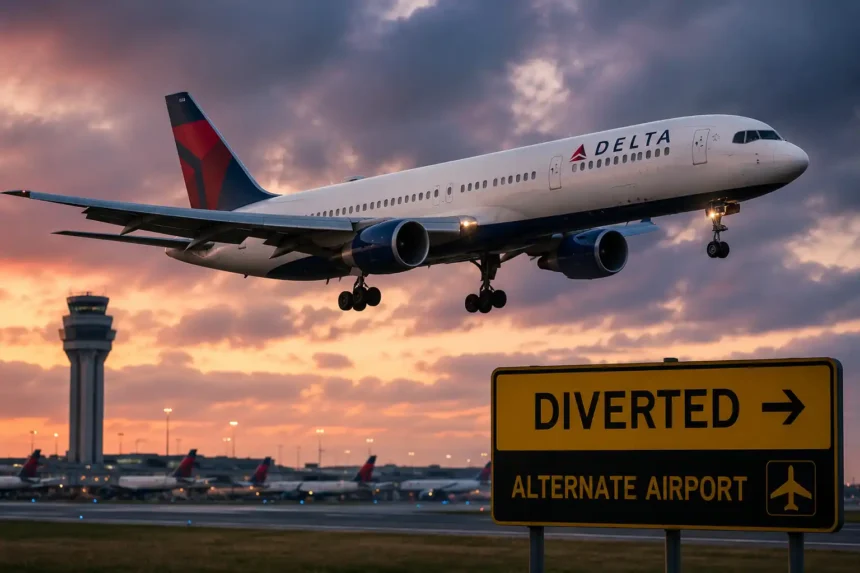
Delta flight DL153 has made headlines more than once — not for its routine Paris-to-Minneapolis crossings, but for a series of mid-flight emergencies that forced the Airbus A330-300 to change course. From a medical crisis over the UK to a mechanical failure that sent the plane back to Charles de Gaulle just 53 minutes after takeoff, this flight number has become one of the most tracked in recent aviation incident history.
- What Happened on Delta Flight DL153: Incident Overview
- What Caused the DL153 Diversion: Emergency Reasons Explained
- How the Emergency Was Handled: Crew and ATC Response
- Why Pilots Returned to Paris Instead of the Nearest Airport
- Delta’s Official Statement and Apology to Passengers
- What Happened to Passengers After the DL153 Diversion
- Passenger Rights and Compensation After DL153 Diversion
- Flight DL153 Route and Aircraft Background
- Aviation Safety Context: How Common Are Flight Diversions
- Conclusion
- FAQs
If you were on board, waiting for a loved one in Minneapolis, or simply following aviation news, here is everything confirmed about each DL153 diversion — including causes, crew decisions, passenger rights, and compensation options.
What Happened on Delta Flight DL153: Incident Overview
DL153 operates daily between Paris Charles de Gaulle Airport (CDG) and Minneapolis-Saint Paul International Airport (MSP) — a transatlantic route covering roughly 6,774 km (4,209 miles) in an average of 8 hours and 22 minutes. The aircraft of choice is typically an Airbus A330-300 widebody.
Three separate diversion events have occurred on this flight number, each tracked in real time via tools like FlightAware, Flightradar24, and AirNav Radar.
July 2024 Incident: Emergency Diversion to London Gatwick
On July 9, 2024, DL153 departed Paris CDG at approximately 10:40 CEST, operated by an Airbus A330-300 registered N804NW — a 20.8-year-old aircraft that previously flew under Northwest Airlines before joining the Delta fleet in October 2008.
About one hour into the flight, while climbing through FL240 over UK airspace near Birmingham, the crew activated squawk 7700 — the universal transponder code for a general emergency. Air traffic control immediately vectored the aircraft toward London Gatwick (LGW).
The plane landed on runway 08R at approximately 11:10 am local time. Fire trucks met it on the runway, a standard protocol when a heavy aircraft lands with a full fuel load. The confirmed cause: a medical emergency on board. Following a short stop, flight DL153 departed from Gatwick again at 13:43 BST and continued its journey to Minneapolis.
November 2025 Incident: Emergency Return to Paris CDG
On November 26, 2025, the same flight departed from runway 27R at Paris CDG at 10:30 a.m. local time, this time carrying 250 passengers and crew aboard an A330-300 registered N807NW.
The aircraft stopped its climb at just 9,000 feet — well below normal cruising altitude. Cockpit alarms signaled a technical malfunction, later identified as a flap deployment anomaly. The adjustable wing surfaces that help control lift during takeoff and landing had failed to retract properly, destabilizing the aircraft’s efficiency with a full transatlantic fuel load on board.
Pilots declared squawk 7700, turned the aircraft back toward Paris, and touched down safely at 11:23 a.m. — just 53 minutes after wheels-up. Delta confirmed the flight was cancelled due to an operational issue and arranged alternate travel for all passengers.
May 2025 Incident: Diversion to Boston Logan
On May 25, 2025, a third aircraft — N826NW, an Airbus A330-302 — departed Paris CDG at 16:56 CEST, already running nearly an hour late. While tracking over Canada, the aircraft diverted to Boston Logan International Airport (BOS) for reasons that were not publicly disclosed at the time. The airline planned a resumption from Boston at approximately 7:30 pm local time.
What Caused the DL153 Diversion: Emergency Reasons Explained
Across three incidents, two distinct categories of emergency triggered DL153’s diversions:
Mechanical failures drove the November 2025 and possibly the May 2025 events. In November, the confirmed cause was a flap deployment anomaly — the aircraft’s wing flaps failed to retract after takeoff, creating aerodynamic instability that made continuing a nine-hour overwater flight unsafe.
A medical emergency caused the July 2024 diversion. With no confirmed details about the specific passenger situation, aviation norms dictate that when a passenger’s condition cannot be managed in the air, the nearest suitable airport becomes the priority.
Other common causes for in-flight diversions — though unconfirmed in DL153’s case for the May 2025 event — include electrical problems, engine warnings, cabin pressure anomalies, and cockpit system alerts.
What Is Squawk 7700 and What Does It Mean
When a crew sets their transponder to 7700, it sends an immediate distress beacon to all air traffic control facilities tracking that aircraft. It does not mean a crash is imminent. It means the crew is declaring a general emergency and requesting priority handling.
The moment ATC receives a 7700 signal, several things happen simultaneously:
- Emergency alarms activate at the relevant control centers
- The aircraft receives priority routing and is cleared for airspace
- Ground crews at the diversion airport mobilize, including fire trucks and medical personnel
- All other traffic yields to the emergency aircraft
In DL153’s November 2025 case, ground controllers at CDG cleared runways and had emergency teams in position before the A330 completed its 53-minute return arc over French airspace.
How the Emergency Was Handled: Crew and ATC Response
One detail that stands out across all three DL153 incidents is how methodically the crews responded. In the November 2025 event, pilots identified the flap issue before reaching the point of no return over the North Atlantic — a critical window where turning back becomes logistically far more complex.
Once squawk 7700 was activated, the crew ran standard emergency checklists while keeping passengers informed via calm intercom announcements. Passengers reported an orderly cabin throughout the return. Fire crews and medical personnel were staged along the runway on arrival, as required by emergency landing protocols at any major international airport.
This is exactly how crew training is designed to work. The controlled nature of the diversion — no injuries, no structural damage, safe touchdown — reflects a system functioning as intended rather than a failure of any kind.
Why Pilots Returned to Paris Instead of the Nearest Airport
A question that surfaces after almost every return-to-origin diversion: why not land at the closest airport?
The response ultimately depends on how serious the emergency situation is. Aviation regulations distinguish between malfunctions that require immediate landing at the nearest suitable airport and those that permit a controlled return to the departure point. A flap retraction issue, while serious enough to warrant a squawk 7700, is not necessarily in the same category as an engine fire or rapid decompression.
Returning to Paris CDG offered several operational advantages:
- Full maintenance infrastructure to inspect and repair the aircraft
- Delta ground staff already in place to handle 250 passengers
- Departure-airport familiarity for ground operations and rebooking
- Existing fuel and logistics contracts on site
As one aviation community observer noted after the incident, the departure airport is often the best option for “less significant” malfunctions — one where the airline can actually fix the problem and get the aircraft back into service efficiently.
Delta’s Official Statement and Apology to Passengers
Following the November 2025 return, Delta Air Lines issued a direct response confirming the cause and outcome. A Delta spokesperson stated that the aircraft “landed safely without incident” and that Delta teams worked to place all affected customers on other departing flights.
The airline also issued a formal apology: “At Delta, nothing is more important than the safety of our customers and people, and we apologize for their experience and the delay in their travel plans.”
No equivalent public statement was issued for the May 2025 Boston diversion, though the airline did arrange onward service from Logan. For the July 2024 Gatwick event, Delta coordinated the continuation of the flight later the same day.
What Happened to Passengers After the DL153 Diversion
Passenger experience varied across the three events:
| Incident | Diversion Airport | Outcome for Passengers |
| July 2024 | London Gatwick (LGW) | Flight resumed the same day at 13:43 BST |
| May 2025 | Boston Logan (BOS) | Onward departure planned ~7:30 pm |
| November 2025 | Paris CDG (return) | Flight cancelled; passengers rebooked on alternate flights |
In the November 2025 case, Delta arranged alternate flights for all 250 passengers from CDG. Those facing longer delays were typically entitled to meal vouchers and, depending on delay length, hotel accommodation under applicable regulations.
Passenger Rights and Compensation After DL153 Diversion
Because DL153 departs from Paris Charles de Gaulle, EU Regulation 261/2004 applies to all passengers on this route — regardless of whether they hold US or European citizenship.
Under EC 261/2004, passengers may be entitled to:
- Up to €600 in compensation for significant delays caused by circumstances within the airline’s control
- Rebooking on the next available flight to their destination at no extra cost
- Hotel accommodation if the delay extends overnight
- Meals and refreshments during the waiting period
For the November 2025 mechanical diversion, the flap failure falls under the airline’s operational responsibility — meaning compensation claims have a strong basis. Technical faults that could have been detected during routine maintenance generally do not qualify as “extraordinary circumstances” under EC 261.
US-based passengers also retain rights under DOT guidelines, though these are typically less comprehensive than the EU framework. Travel insurance policies that include trip interruption coverage may provide additional reimbursement for hotels, rebooking fees, and missed connections.
To file a claim, passengers should contact Delta customer service directly and reference the flight number, date, and departure airport. If Delta disputes the claim, third-party claims services can assist with EU261 submissions.
Flight DL153 Route and Aircraft Background
| Detail | Data |
| Route | Paris CDG → Minneapolis MSP |
| Distance | 6,774 km / 4,209 miles |
| Average flight time | 8 hours 22 minutes |
| Average speed | 812 km/h / 505 mph |
| Frequency | Daily (7 flights per week) |
| Aircraft type | Airbus A330-300 / A330-302 |
| MSP arrival terminal | Terminal 1 |
| Average delay rate | ~40% of flights are delayed |
| Average delay duration | 18 minutes |
The A330-300 is a reliable widebody aircraft with a strong safety record on long-haul routes. The registrations involved across the three incidents — N804NW, N807NW, and N826NW — are all former Northwest Airlines airframes that joined Delta’s fleet following the 2008 merger.
Aviation Safety Context: How Common Are Flight Diversions
Emergency diversions on transatlantic routes are rare but not exceptional. Airlines operating long-haul services over large bodies of water maintain strict protocols precisely because diversion options mid-ocean are limited. The North Atlantic corridor is among the most closely managed airspaces in the world, with dedicated oceanic tracks and continuous ATC coordination between US, Canadian, and European centers.
IATA data consistently places commercial aviation among the safest forms of transportation globally. The fact that three DL153 incidents resulted in zero injuries and fully controlled outcomes reflects a system with multiple redundant safety layers — from pilot training and real-time system monitoring to ATC coordination and emergency ground response.
FAA and EASA both maintain oversight of transatlantic operations, and each diversion triggers an incident report that feeds into broader fleet safety analysis. The A330-300’s reliability record remains strong across the global fleet despite these events.
Conclusion
Three diversions on the same flight number within roughly 18 months is unusual, but each was handled professionally, with no injuries and full passenger accommodation. The DL153 incidents highlight how aviation safety protocols are designed to work — catching problems early, prioritizing crew and passenger safety over schedule, and keeping everyone informed throughout.
For passengers directly affected, EU Regulation 261/2004 provides a solid framework for compensation claims, particularly when mechanical causes are confirmed. Understanding those rights — and acting on them promptly — is the most practical takeaway from any diversion experience.
FAQs
FAQ 1: What caused Delta Flight DL153 to declare an emergency?
The cause varied by incident. In November 2025, Delta confirmed a flap deployment anomaly — the A330-300’s wing flaps failed to retract after takeoff from Paris CDG, prompting pilots to declare squawk 7700 and return to the airport. In July 2024, the confirmed cause was a medical emergency on board, which diverted the aircraft to London Gatwick. The May 2025 Boston diversion reason was not publicly disclosed.
FAQ 2: Was anyone hurt during the DL153 diversion?
None of the three incidents resulted in any reported injuries. All 250 passengers and crew aboard the November 2025 flight landed safely. The July 2024 medical diversion also concluded without further incident after landing at London Gatwick, where emergency personnel were standing by.
FAQ 3: What is squawk 7700 and why did DL153 use it?
Squawk 7700 is a universal transponder code that alerts all air traffic control facilities to a general emergency. When a crew sets this code, ATC immediately clears airspace around the aircraft, activates ground emergency response teams, and provides priority routing to the nearest suitable airport. It does not automatically indicate a life-threatening situation — it signals that the crew needs priority handling and is declaring an emergency under standard aviation protocol.
FAQ 4: Why did Delta pilots return to Paris instead of landing at a closer airport?
For the November 2025 incident, the flap anomaly was assessed as serious enough to declare an emergency but not severe enough to require landing at the absolute nearest airfield. Returning to Paris CDG gave Delta access to full maintenance infrastructure, an established ground crew capable of handling 250 displaced passengers, and the resources needed to inspect and repair the aircraft. Aviation regulations allow crews to return to their departure airport when the malfunction permits a controlled, non-urgent diversion.
FAQ 5: What are passenger rights after the DL153 diversion or cancellation?
Passengers on DL153 departing Paris CDG fall under EU Regulation 261/2004. If the diversion was caused by a mechanical issue within the airline’s control — as in November 2025 — passengers may be entitled to up to €600 in compensation, plus rebooking on the next available flight, meal vouchers during the wait, and hotel accommodation for overnight delays. US travelers may also have additional protections under DOT guidelines. Contact Delta customer service with your flight number, date, and departure airport to initiate a claim.
FAQ 6: How many times has Delta Flight DL153 been diverted?
At least three confirmed diversion events have occurred under the DL153 flight number: July 2024 (London Gatwick, medical emergency), May 2025 (Boston Logan, undisclosed cause), and November 2025 (return to Paris CDG, flap failure). Each involved a different A330-300 aircraft registration — N804NW, N826NW, and N807NW, respectively.
FAQ 7: How common are emergency diversions on transatlantic flights?
Diversions on transatlantic routes are relatively rare. Most long-haul flights complete without incident, and when diversions do occur, they almost always end safely. Aviation authorities, including the FAA and EASA, require airlines to maintain strict emergency procedures for exactly these situations. The North Atlantic corridor is one of the most heavily monitored airspaces in the world, giving crews and controllers maximum coordination capability when problems arise.
FAQ 8: Was Delta Flight DL153 cancelled or rescheduled after the diversion?
It depends on the incident. The November 2025 flight was fully cancelled after returning to Paris CDG, with Delta rebooking all affected passengers on alternate departures. The July 2024 London Gatwick diversion ended with the flight resuming later the same day, departing Gatwick at 13:43 BST and continuing to Minneapolis. For the May 2025 Boston diversion, Delta planned an onward departure from Boston Logan at approximately 7:30 pm the same evening.