





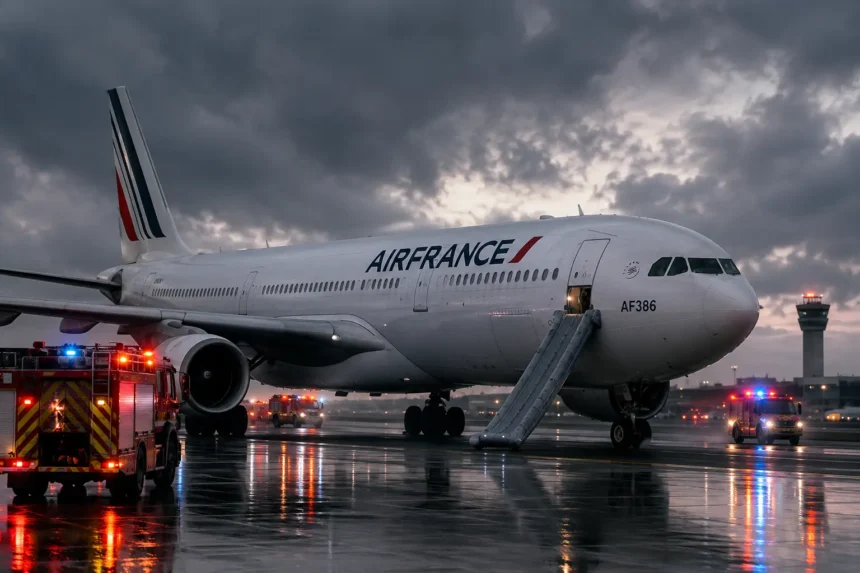
On June 9, 2025, Air France flight AF386 departed Paris Charles de Gaulle Airport bound for Toronto Pearson — a routine transatlantic crossing that turned into one of the most-tracked aviation incidents of the month. Shortly after reaching cruising altitude, the Boeing 777-300ER declared a general emergency, circled over Normandy to dump fuel, and returned safely to CDG. No injuries. No catastrophic failure. But plenty of unanswered questions.
- What Happened to Air France Flight AF386? — Full Incident Overview
- What Was the Cause of the AF386 Emergency?
- How Aviation Emergency Protocols Managed the Crisis
- Operational Impact on Air France and CDG Airport
- Passenger Experience and Handling After the Emergency Return
- Public Perception, Passenger Confidence, and Media Impact
- Lessons for the Aviation Industry and Proactive Safety Measures
- Air France’s Response and What Comes Next
- Conclusion
- FAQs
Here is a clear, factual breakdown of everything that happened, why it matters, and what it reveals about how aviation handles emergencies at 30,000 feet.
What Happened to Air France Flight AF386? — Full Incident Overview
AF386 lifted off from CDG at 18:52 CEST, scheduled for an 8-hour 10-minute flight to Toronto Pearson (YYZ). The aircraft climbed normally until something changed.
Near the Channel Islands — specifically west of Guernsey in the English Channel — the flight crew activated squawk code 7700, the international transponder signal for a general emergency. The plane descended from 32,000 feet to FL300 (30,000 feet) and entered a holding pattern over Normandy to burn and dump fuel before any emergency landing attempt.
Aviation tracking platforms, including AirNav Radar, lit up immediately. Thousands of people monitored the aircraft’s path in real time as the situation developed.
Aircraft Details and Fleet Background
The aircraft involved was registered as F-GSQS, a Boeing 777-300ER — also listed as a Boeing 777-328ER in some records. As of June 2025, this specific aircraft was approximately 18.4 years old, having been delivered to Air France in January 2007.
| Detail | Data |
| Registration | F-GSQS |
| Aircraft Type | Boeing 777-300ER |
| Age | 18.4 years |
| Delivered | January 2007 |
| Air France 777-300ER Fleet | 43 total |
| Active Aircraft | 38 |
| Parked Aircraft | 5 |
| Average Fleet Age | 16.8 years |
Air France operates 43 Boeing 777-300ERs, making this variant a central workhorse for its long-haul international network. The fact that F-GSQS sits above the fleet’s average age of 16.8 years drew attention from aviation communities once the incident went public.
Chronological Timeline of the Emergency
| Time (CEST) | Event |
| 18:52 | AF386 departs Paris CDG for Toronto |
| ~19:10 | Emergency declared near Channel Islands; squawk 7700 activated |
| 20:10 | Aircraft circling at 30,000 feet to burn fuel |
| 20:15 | Confirmed: flight will return to Paris |
| 20:20 | Boeing 777 exits holding pattern, routing back to CDG |
| 20:50 | AF386 on final approach to runway 27L |
| 20:57 | Touchdown; aircraft vacates via taxiway Y1 |
| 21:08 | Returned to Terminal 2E |
| 21:10 | Air France confirms technical issue; aircraft grounded |
The entire sequence — from emergency declaration to wheels on the ground — lasted roughly two hours.
What Was the Cause of the AF386 Emergency?
Air France issued a statement confirming that the crew decided to return to CDG “in accordance with manufacturer procedures and company guidelines” due to a technical incident that did not affect the aircraft’s airworthiness.
That last detail matters. Airworthiness unaffected means the aircraft could fly — but the crew chose caution over continuation. That is exactly how properly trained flight crews should respond.
Beyond that, the specific technical fault was never publicly disclosed. Aviation regulators, including the BEA (Bureau of Enquiry and Analysis for Civil Aviation Safety), EASA, and the FAA, may conduct reviews, particularly given that a second Air France Boeing 777-300ER flight AF116 to Shanghai had declared an emergency just 24 hours earlier on June 8, 2025, while flying over Romania.
Two emergencies. Two Boeing 777-300ERs. Two consecutive days. That pattern was not lost on the aviation community.
How Aviation Emergency Protocols Managed the Crisis
What the AF386 incident demonstrates clearly is that aviation’s layered safety system works. When the crew activated squawk 7700, it immediately triggered a coordinated response involving air traffic controllers, CDG ground operations, and emergency response teams standing by on the tarmac.
The decision to enter a holding pattern first — rather than immediately divert — reflects sound emergency procedure. By burning and dumping fuel over Normandy, the crew reduced the aircraft’s weight to within its maximum certified landing weight. Landing an overweight wide-body jet carries risks. The holding pattern eliminates that risk before it becomes a problem.
The Role of the Flight Crew and Air Traffic Controllers
Aviation professionals rarely make emergency decisions alone. In this case, the pilots consulted with ground technicians while circling, evaluated the aircraft’s system status against emergency checklists, and coordinated descent routing with ATC to avoid congested airspace around CDG.
The result: a textbook emergency return. No passenger injuries. No structural damage. Runway 27L cleared and ready.
Proper crew training makes the difference between a controlled return and a genuine crisis. This crew demonstrated exactly why simulator-based emergency drills matter on real-world flights.
What Is a Squawk 7700 Code and What Does It Mean?
Squawk 7700 is a four-digit transponder code that a pilot dials into the aircraft’s transponder to declare a general emergency to air traffic control. It broadcasts automatically on radar systems and alerts every controller monitoring that airspace.
Unlike squawk 7500 (hijacking) or 7600 (radio failure), 7700 covers everything else — mechanical issues, medical emergencies, fire warnings, and more. Once activated, ATC clears the airspace around the affected aircraft and coordinates priority handling. Live flight tracking platforms like AirNav Radar display the code publicly, which is why AF386’s emergency spread so rapidly across social media.
Operational Impact on Air France and CDG Airport
An unplanned return of a widebody Boeing 777-300ER does not happen in isolation. The aircraft was immediately taken out of service pending a full technical evaluation, which cascaded into schedule disruptions across Air France’s network.
Key operational consequences included:
- Delayed and cancelled connecting flights for passengers who had onward bookings from Toronto
- Air traffic slot disruptions at CDG, as returning emergency aircraft require priority handling
- Emergency response team deployment, temporarily affecting ground operations logistics
- Crew scheduling adjustments, since the AF386 crew exceeded operational parameters after the extended diversion
Airlines running at high load factors — particularly post-pandemic, when capacity pressure remains intense — absorb these disruptions with limited slack. One grounded widebody on a transatlantic route creates a ripple that reaches airports on two continents.
Passenger Experience and Handling After the Emergency Return
Over 200 passengers on board AF386 landed back at CDG roughly two hours after they had departed — back at terminal 2E, bags still checked, plans disrupted.
Air France ground teams met the aircraft and began the process of managing irregular operations:
- Rebooking on the next available Paris–Toronto departure
- Accommodations for passengers who could not travel the same day
- Meal vouchers provided during the delay period
- Connecting flight assistance for passengers with onward travel from Toronto
For travelers with tight layovers at YYZ — or urgent plans on the Canadian side — the disruption caused major inconvenience. International routes offer fewer rebooking options than domestic ones, and Paris–Toronto has limited daily frequency.
The emotional dimension also deserves acknowledgment. Passengers on board did not know the cause of the emergency. That uncertainty, combined with the physical sensation of circling and descending unexpectedly, is unsettling regardless of how routine the crew treats the situation internally.
Public Perception, Passenger Confidence, and Media Impact
The words “emergency” and “fuel dump” hitting live flight trackers and social media simultaneously created a wave of public concern that outpaced the actual risk level of the incident.
In 2025, aviation incidents will no longer develop quietly. Platforms like AirNav Radar and FlightAware make every squawk 7700 visible to hundreds of thousands of followers within minutes. News outlets pick it up before the aircraft lands. By the time Air France issued its official statement, the story had already framed itself across global media.
This is the new reality airlines navigate alongside the technical emergency itself — a parallel information emergency that shapes passenger confidence, whether or not it reflects the actual severity of events.
The AF116–AF386 back-to-back incident pattern amplified this effect considerably, raising questions about Air France’s aging 777-300ER fleet and triggering scrutiny that a single isolated emergency might not have generated.
Lessons for the Aviation Industry and Proactive Safety Measures
AF386 ended safely. But it surfaces important questions that the aviation industry must answer proactively rather than reactively:
- Are inspection cycles keeping pace with the operational demands placed on aging long-haul aircraft?
- Does real-time technical monitoring allow ground teams to detect developing faults before pilots encounter them at 32,000 feet?
- Are crew training programs — specifically emergency decision-making drills — updated to reflect current aircraft system complexities?
Regulators, including EASA and the FAA, are expected to review incidents involving repeated technical events on the same aircraft type within compressed timeframes. The Boeing 777-300ER has a strong safety record historically, but a pattern of emergencies invites scrutiny regardless of individual outcomes.
Post-pandemic demand pressure has pushed airlines to maximize utilization. Rushing aircraft through maintenance windows to meet capacity targets is a documented industry pressure point. Robust safety standards require that operational efficiency never takes priority over thorough technical evaluation — especially on mature aircraft like F-GSQS.
Air France’s Response and What Comes Next
Air France acted correctly from a procedural standpoint. The crew followed manufacturer guidelines. Passengers were assisted. The aircraft was grounded pending evaluation. Statements were issued promptly.
What matters now is what happens beyond the immediate response. F-GSQS’s return to commercial service should follow a complete technical review — not a minimum-threshold check before the next scheduled departure. Given the public visibility of this incident and the AF116 timing, Air France’s credibility rests partly on demonstrating that transparency extends into maintenance decisions, not just crisis communications.
Trust in air travel rebuilds through consistent action, not press releases.
Conclusion
Air France flight AF386 returned safely to Paris CDG on June 9, 2025, after declaring a general emergency near Guernsey and circling over Normandy to dump fuel. The Boeing 777-300ER registration F-GSQS landed without injuries, and over 200 passengers were assisted by Air France teams at the airport.
The cause remained officially undisclosed, though Air France confirmed the technical issue did not compromise airworthiness. Emergency protocols performed as designed. The flight crew made sound decisions under pressure. And yet the incident raises legitimate questions — about aging fleet management, inspection thoroughness, and the twin emergencies that occurred within 24 hours on the same aircraft type.
Aviation safety is not measured by single outcomes. It is measured by the systems, habits, and decisions that exist long before an emergency is ever declared.
FAQs
FAQ 1: What caused the AF386 emergency on June 9, 2025?
Air France confirmed a technical issue forced the return, but did not disclose the specific fault. The airline stated the incident did not affect the aircraft’s airworthiness, and the crew followed manufacturer procedures. As of the latest reporting, the exact cause remains under review.
FAQ 2: What does squawk 7700 mean in aviation?
Squawk 7700 is a universal transponder code pilots activate to declare a general emergency to air traffic control. It alerts ATC across all monitoring radar systems instantly and triggers priority handling, airspace clearance, and emergency response coordination on the ground.
FAQ 3: Did Air France flight AF386 land safely?
Yes. AF386 touched down safely on runway 27L at Paris CDG at 20:57 CEST, vacating via taxiway Y1 and returning to terminal 2E by 21:08 CEST. No injuries were reported among the 200+ passengers and crew onboard.
FAQ 4: Why did AF386 circle and dump fuel before landing?
The Boeing 777-300ER carries significantly more fuel at takeoff than its maximum certified landing weight allows. Before an emergency landing, the crew entered a holding pattern over Normandy at 30,000 feet to burn and dump fuel, reducing the aircraft’s weight to a safe landing threshold.
FAQ 5: What is the registration and age of the AF386 aircraft?
The aircraft was registered F-GSQS, a Boeing 777-300ER delivered to Air France in January 2007. At the time of the incident, it was approximately 18.4 years old — older than Air France’s average 777-300ER fleet age of 16.8 years across 43 aircraft.
FAQ 6: How were passengers on AF386 assisted after the emergency return?
Air France ground teams met passengers at terminal 2E and arranged rebooking on the next available Paris–Toronto flights. The airline also provided meal vouchers, accommodation where needed, and assistance for affected connecting flight bookings.
FAQ 7: Was this the only Air France emergency during that period?
No. Just one day earlier, on June 8, 2025, Air France flight AF116 — also a Boeing 777-300ER — declared an emergency while flying over Romania en route to Shanghai Pudong and returned to Paris. Two emergency incidents involving the same aircraft model within 24 hours attracted major attention across the aviation industry.
FAQ 8: What safety agencies may investigate the AF386 incident?
The BEA (Bureau of Enquiry and Analysis for Civil Aviation Safety), France’s primary aviation investigation authority, holds jurisdiction over this incident. EASA and the FAA may also conduct safety reviews, particularly given the back-to-back nature of the AF116 and AF386 emergencies involving Boeing 777-300ER aircraft.