





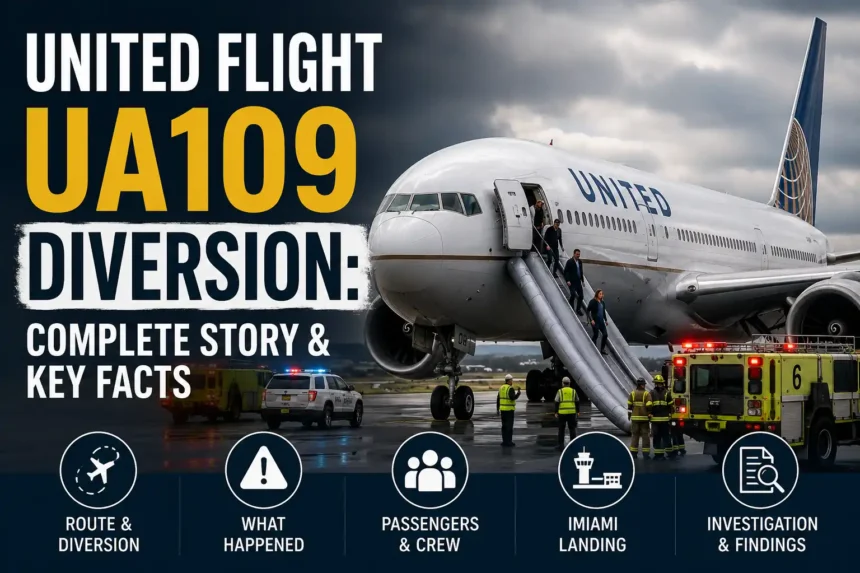
On October 30, 2025, the diversion of United Flight UA109 transformed a routine transatlantic journey into a widely discussed aviation incident. The Boeing 787-8 Dreamliner, operating its scheduled route from Munich Airport (MUC) to Washington Dulles International Airport (IAD), made an unplanned stop at Dublin Airport (DUB) in Ireland. No engine failed. No storm hit. No security threat triggered the turn. A single crew member’s medical condition made it legally impossible to continue — and that one fact changed everything for everyone onboard.
- What Is United Flight UA109?
- Overview of the United Flight UA109 Diversion
- What Caused the United Flight UA109 Diversion?
- Full Timeline of Events — October 30, 2025
- Why Dublin Airport Was Chosen for the Diversion
- Why the Pilots Could Not Legally Continue to Washington
- The Mid-Atlantic U-Turn — What It Looked Like
- Passenger Experience During the United Flight UA109 Diversion
- How United Airlines Handled the Situation
- Aviation Safety Regulations and Lessons from UA109
- How Common Are Flight Diversions on Transatlantic Routes?
- Financial and Operational Costs of a Flight Diversion
- What Travelers Should Know About Flight Diversions
- Conclusion
- FAQs
What Is United Flight UA109?
UA109 is a United Airlines long-haul transatlantic route that connects Munich, Germany, directly with Washington Dulles. The route typically runs 8 to 9 hours and crosses the North Atlantic corridor, serving a mix of business travelers, tourists, diplomats, and government officials moving between Central Europe and the U.S. East Coast.
The aircraft assigned to this service is the Boeing 787-8 Dreamliner — a twin-engine wide-body built specifically for extended intercontinental operations. United Airlines runs similar transatlantic services from Newark to Frankfurt and Newark to London, making UA109 one part of a much larger North Atlantic network.
| Detail | Information |
| Airline | United Airlines |
| Flight Number | UA109 |
| Route | Munich (MUC) → Washington Dulles (IAD) |
| Aircraft | Boeing 787-8 Dreamliner |
| Typical Duration | 8–9 hours |
| Incident Date | October 30, 2025 |
| Diversion Airport | Dublin Airport (DUB), Ireland |
Overview of the United Flight UA109 Diversion
The flight departed Munich at 12:14 PM CET and climbed normally to cruising altitude over European airspace. Everything proceeded without incident for the first segment of the journey. Then, roughly 90 minutes into the flight and well into the North Atlantic, a crew member reported severe pain that prevented her from performing her required duties.
The captain assessed the situation quickly, coordinated with the airline operations center on the ground, and made the call: divert. The Boeing 787-8 executed a controlled U-turn at cruising altitude and headed east toward Ireland. The aircraft landed safely at Dublin Airport at approximately 3:00 PM GMT. After medical evaluation, operational checks, and refueling, the flight departed Dublin at 4:20 PM and arrived at Washington Dulles at 6:15 PM local time — about two hours behind schedule.
No emergency declaration was made. No passengers were in danger. The entire sequence was a regulatory response, not a crisis.
What Caused the United Flight UA109 Diversion?
The cause was a severe foot blister affecting a flight attendant. While that may sound minor on the ground, at 40,000 feet over the Atlantic it carries serious regulatory weight.
Cabin crew members are not simply hospitality staff. They are certified safety personnel responsible for passenger evacuations, fire response, emergency door operations, and first-aid coordination. Aviation regulations under both the FAA and EASA require that every long-haul flight maintains a minimum number of physically capable crew members throughout the journey.
When this flight attendant’s condition made it impossible for her to stand, walk, or perform safety duties, the flight became non-compliant. The crew vs. passenger medical difference matters here — a sick passenger does not trigger the same regulatory requirement. A incapacitated crew member does. Continuing to Washington Dulles under those conditions was not a judgment call. It was legally prohibited.
Full Timeline of Events — October 30, 2025
Departure and Initial Cruise
UA109 pushed back from the gate in Munich at 12:14 PM CET and took off on schedule. The flight climbed to cruising altitude and tracked east-to-west across European airspace into the North Atlantic. For the first portion of the journey, everything ran normally.
Medical Emergency Reported Mid-Atlantic
Approximately 90 minutes into the flight — placing the aircraft roughly 500 to 600 nautical miles west of Ireland — a flight attendant reported severe foot pain. The blister had worsened significantly during the early hours of the flight, reaching a point where she could no longer stand or move safely. The crew flagged the situation to the flight deck.
Crew Assessment and Diversion Decision
The captain and flight deck personnel reviewed the situation against FAA and EASA standards. They consulted with ground-based doctors via radio links and coordinated with the airline operations center. Fuel levels were checked. Weather along the return path was assessed. Dublin met every required criteria — closest suitable alternate, widebody-capable runways, 24-hour medical support. The diversion decision was made within minutes.
Landing, Stop, and Resumption
Dublin’s emergency response teams were positioned and ready when the aircraft touched down at approximately 3:00 PM GMT. The crew member received medical attention on the ground. The aircraft underwent operational checks and refueling. Passengers remained onboard during this period and were provided refreshments. The flight departed Dublin at 4:20 PM and landed at Washington Dulles at 6:15 PM — a delay of roughly two hours from the original schedule.
Why Dublin Airport Was Chosen for the Diversion
Dublin does not end up as the diversion point by coincidence. Airlines pre-designate alternate airports before every transatlantic departure, and Dublin appears on those lists for well-documented reasons.
Strategic Atlantic Location
Dublin sits directly along the major North Atlantic flight routes connecting Europe and North America. For westbound flights in the first two to three hours of an Atlantic crossing, it often represents the nearest suitable landing option. The moment a crew issue was confirmed on UA109, Dublin was already the logical answer.
Medical and Emergency Infrastructure
The airport maintains round-the-clock professional medical services capable of meeting diverted aircraft immediately on landing. Ground-based medical teams, aircraft rescue units, and international passenger handling facilities are all available without advance notice.
Runway Capacity for Widebody Aircraft
Dublin’s runway infrastructure comfortably handles large aircraft, including the Boeing 787-8 Dreamliner and Boeing 777. No special clearance or weight restriction applied.
ETOPS Designation
UA109 operates under ETOPS — Extended-range Twin-engine Operational Performance Standards — which governs how twin-engine aircraft fly routes far from land. These regulations require airlines to identify and file approved alternate airports before every ocean crossing. Dublin holds primary alternate designation for a significant portion of North Atlantic traffic, which is why it was already in the plan before the aircraft even left Munich.
Why the Pilots Could Not Legally Continue to Washington
This is the part that surprises most people. The aircraft itself was fully functional. The weather was fine. Yet the captain had no legal option to continue.
FAA and EASA regulations define minimum crew requirements based on the aircraft type, flight duration, and route. When one crew member becomes physically unable to fulfill safety duties, the flight falls out of compliance with those mandatory requirements. No airline operations center can override that standard, regardless of schedule pressure or cost.
The captain’s role in this situation was not to decide whether to divert — that was already determined by regulation. The role was to execute the diversion efficiently, protect the remaining crew, and keep passengers informed. That is precisely what happened.
The Mid-Atlantic U-Turn — What It Looked Like
People tracking UA109 on flight apps saw the aircraft make what looked like a dramatic 180-degree turn over open ocean. From the outside, it raised immediate alarm. From inside the cabin, passengers felt nothing more than a gradual bank — comparable to a wide curve on a highway.
The Boeing 787-8 Dreamliner is engineered for exactly this kind of maneuver at altitude. The turn was smooth, controlled, and handled entirely by standard aircraft systems with ATC coordination. The “drama” existed only on radar screens. In reality, it was a textbook course correction.
Passenger Experience During the United Flight UA109 Diversion
Most passengers were eating, watching films, or sleeping when the cabin announcement came. The shift from routine to unexpected created natural confusion and anxiety — particularly for those who noticed the change on flight tracking apps before any announcement was made.
What made the difference was how the crew communicated. The explanation was clear: a safety-related situation required landing in Dublin, everything was under control, and the flight would continue to Washington once cleared. That kind of direct, calm communication prevented panic from spreading.
Passengers were not deplaned. They waited onboard, received refreshments, and the overall atmosphere remained composed throughout the stop.
How United Airlines Handled the Situation
United’s response reflected standard global aviation practices rather than reactive crisis management. The airline:
- Kept passengers onboard during the Dublin stop
- Provided refreshments during the ground delay
- Resumed the flight on the same aircraft once clearance was granted
- Achieved a final delay of approximately two hours — minimal given the circumstances
Behind the scenes, the airline operations center coordinated ground handling at Dublin, managed crew logistics, and communicated with air traffic control throughout. The speed of the turnaround — from unscheduled landing to resumed flight — reflected solid pre-planning and efficient execution.
Aviation Safety Regulations and Lessons from UA109
FAA and EASA Crew Compliance Rules
Both the FAA and EASA mandate minimum crew numbers based on aircraft type and route length. Physical capability is not assumed — it must be maintained throughout the flight. A crew member who cannot perform evacuation, fire response, or emergency door duties no longer counts toward that minimum. The moment UA109 fell below its required threshold, the regulatory path was clear.
ETOPS Planning and Alternate Airport Requirements
ETOPS rules exist specifically because twin-engine aircraft flying ocean routes spend long periods far from emergency landing options. Airlines must file approved alternate airports — with adequate facilities and runway capacity — as part of every pre-flight plan. This requirement meant Dublin was already identified and approved before UA109 left Munich.
Human Factors in Aviation Safety
What UA109 illustrates is that safety culture in commercial aviation accounts for human factors as rigorously as mechanical ones. Crew fitness is not a secondary concern — it is a core operational variable. The system worked exactly as designed: a potential problem was identified early, a precautionary diversion was executed, and the flight continued without further incident.
How Common Are Flight Diversions on Transatlantic Routes?
Transatlantic diversions occur more frequently than most passengers realize. Medical causes — both passenger and crew — account for a significant share of these incidents annually. Dublin Airport and Shannon Airport serve as the two most common alternate landing points for North Atlantic traffic.
In 2025 and early 2026, several transatlantic flights diverted for crew or passenger health reasons, all following the same structured response pattern as UA109. Response times have improved steadily as training standards and real-time coordination tools have advanced. UA109 fits this pattern precisely — it was not an anomaly.
Financial and Operational Costs of a Flight Diversion
Diversions are expensive. A single unscheduled landing generates costs across multiple categories:
| Cost Category | Impact |
| Extra fuel | Significant — return flight plus extended ground time |
| Airport fees | Unplanned landing and ground handling charges |
| Crew logistics | Additional staff coordination, possible crew rest requirements |
| Passenger rebooking | Missed connections require airline-arranged alternatives |
| Aircraft rotation | Schedule disruption affecting subsequent flights |
Airlines carry insurance that partially covers these costs, but the financial hit is real. Even so, no airline operates under a framework where schedule cost outweighs safety compliance — nor should one.
What Travelers Should Know About Flight Diversions
If your flight diverts, the most useful thing you can do is stay calm and follow crew instructions. Beyond that:
- Document everything — note flight numbers, diversion times, and any announcements made
- Speak to airline staff on the ground — rebooking, missed connections, and accommodation are handled at the gate
- Know your rights — EU261 regulations may apply depending on your departure point, the cause of the diversion, and your final destination
- Check travel insurance — many policies cover additional costs from involuntary diversions
- Use the airline app — real-time updates often appear faster there than through cabin announcements
Most diversions resolve within two to three hours. Airlines have established protocols for these situations, and the priority shifts immediately to getting passengers to their destinations with minimal disruption.
Conclusion
The United Flight UA109 diversion on October 30, 2025, was a clean demonstration of aviation safety working as intended. A flight attendant’s severe blister triggered a regulatory response that the captain could not ignore — and did not. The Boeing 787-8 turned around over the North Atlantic, landed safely at Dublin Airport, and reached Washington Dulles just two hours late.
No one was in danger. No system failed. The decision to divert was not dramatic — it was mandatory. And that, more than anything, is the takeaway: modern commercial aviation operates under a framework where safety before schedule is not a policy statement. It is a legally enforced reality.
FAQs
FAQ 1: What caused the United Flight UA109 diversion?
A flight attendant developed a severe foot blister during the flight that prevented her from standing or performing safety duties. FAA and EASA minimum crew regulations require all essential crew members to remain physically capable throughout the flight. Once she could no longer meet that standard, the captain was legally required to divert.
FAQ 2: Was there any mechanical failure or danger involved?
No. The Boeing 787-8 Dreamliner remained fully operational throughout the incident. There was no mechanical failure, no security threat, and no passenger medical emergency. The diversion was a precautionary regulatory response, not a reaction to any immediate danger.
FAQ 3: Why did the flight divert specifically to Dublin Airport?
Dublin holds ETOPS alternate airport designation for North Atlantic routes, meaning it was already in the pre-filed contingency plan before departure. Its strategic position along the Atlantic corridor, 24-hour medical infrastructure, and runway capacity for widebody aircraft like the Boeing 787 made it the nearest suitable option at the time of diversion.
FAQ 4: How long was the delay caused by the diversion?
The total delay was approximately two hours. The aircraft landed at Dublin at 3:00 PM GMT, departed at 4:20 PM following medical evaluation, operational checks, and refueling, and arrived at Washington Dulles at 6:15 PM local time.
FAQ 5: How were passengers informed and what did they experience?
The crew made a cabin announcement explaining that the flight was diverting for a safety-related reason and that everything was under control. Some passengers had already noticed the course change through flight tracking apps. While initial confusion and anxiety were natural, the clear communication kept the cabin calm throughout.
FAQ 6: What happened to the crew member after landing in Dublin?
Medical teams on the ground met the aircraft upon landing and assessed the crew member at Dublin Airport. She received appropriate medical attention. The rest of the crew completed operational checks before the flight continued to Washington Dulles.
FAQ 7: Can passengers claim compensation for a diverted flight?
It depends on the circumstances. EU261 regulations may apply if the flight departed from an EU airport and the delay at the final destination exceeded three hours. The cause of the diversion also matters — crew medical issues related to safety compliance can affect eligibility. Passengers should contact United Airlines directly and review their travel insurance policy for specific coverage.
FAQ 8: Are mid-Atlantic diversions common, and is flying still safe?
Mid-Atlantic diversions happen regularly, though most go unnoticed publicly. Medical causes — both passenger and crew — account for the majority. Dublin and Shannon airports serve as the two primary alternates for North Atlantic traffic. UA109 fits a well-established pattern of calm, structured responses. Modern aviation in 2026 operates under some of the most rigorous safety systems ever developed, and events like this one are evidence of those systems working correctly — not failing.