




The Phillies vs Colorado Rockies match player stats from their six completed 2026 meetings show a clear overall advantage for Philadelphia. The Phillies won four of the six games and outscored Colorado 35–18. Kyle Schwarber was the matchup’s most dangerous power hitter, while Alec Bohm produced the best Philadelphia batting average against Colorado. The Rockies earned two victories through Mickey Moniak’s power and a dramatic 11-inning win, but Philadelphia’s stronger starting pitching and deeper run production decided the series.
- 2026 Phillies–Rockies Results at a Glance
- What the Six-Game Statistics Reveal
- Phillies vs Colorado Rockies Match Player Stats: Top Philadelphia Hitters
- Colorado Rockies Player Stats and Offensive Standouts
- Starting-Pitching Performances That Shaped the Matchup
- Game-by-Game Player Stats and Turning Points
- Why Philadelphia Won Four of Six Meetings
- How to Read Baseball Match Player Stats Correctly
- Conclusion
- Frequently Asked Questions
2026 Phillies–Rockies Results at a Glance
Philadelphia and Colorado played two three-game sets during the early part of the 2026 season. The first took place at Coors Field from April 3–5, while the second was held at Citizens Bank Park from May 8–10.
| Date | Venue | Final score | Main performance |
| April 3, 2026 | Coors Field | Phillies 10, Rockies 1 | Aaron Nola struck out nine; Philadelphia collected 13 hits |
| April 4, 2026 | Coors Field | Phillies 2, Rockies 1 | Jesús Luzardo recorded 11 strikeouts |
| April 5, 2026 | Coors Field | Rockies 4, Phillies 1 | Mickey Moniak hit two home runs |
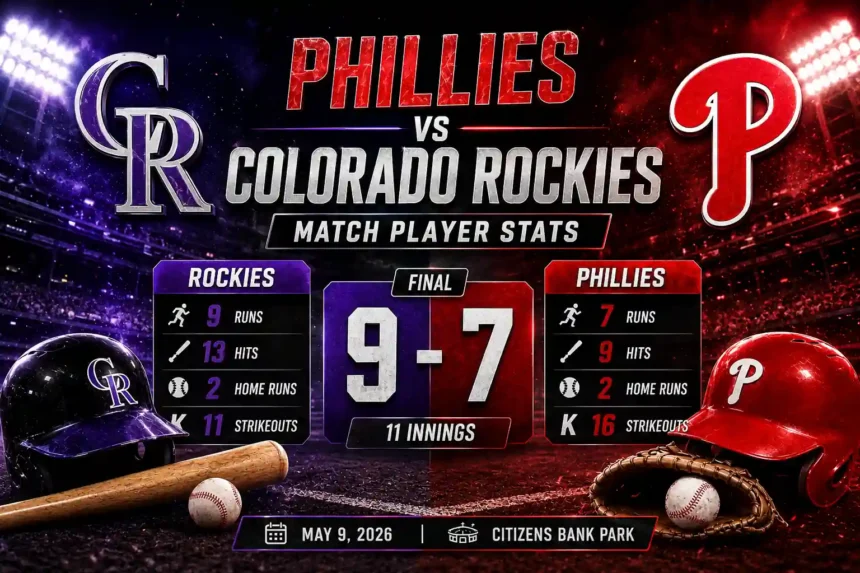
| May 8, 2026 | Citizens Bank Park | Rockies 9, Phillies 7, 11 innings | Troy Johnston delivered the go-ahead double |
| May 9, 2026 | Citizens Bank Park | Phillies 9, Rockies 3 | Alec Bohm homered twice and drove in four |
| May 10, 2026 | Citizens Bank Park | Phillies 6, Rockies 0 | Kyle Schwarber homered twice; Cristopher Sánchez threw seven shutout innings |
The six results produced a 4–2 Philadelphia advantage. Adding the final scores gives the Phillies 35 runs and the Rockies 18, a run differential of plus-17 for Philadelphia. The gap came largely from three convincing Phillies victories: 10–1, 9–3 and 6–0.
The series was not completely one-sided. Colorado won the April finale and survived a major Philadelphia comeback in the May opener. However, the Rockies struggled to sustain their offense from one game to the next. Their nine-run victory on May 8 was followed by only three runs on May 9 and no runs in the finale.
What the Six-Game Statistics Reveal
The results illustrate three major differences between the teams.
First, Philadelphia generated more game-changing extra-base power. Schwarber repeatedly changed games with home runs, Bohm delivered a two-homer performance, Bryce Harper contributed power in the finale, and Justin Crawford hit his first major-league home run during the May 8 comeback.
Second, the Phillies produced the strongest starting-pitching performances. Aaron Nola, Jesús Luzardo and Cristopher Sánchez each controlled a game, combining run prevention with high strikeout totals. Colorado received competitive work in portions of the series, but its starters were more vulnerable to concentrated scoring rallies.
Third, Philadelphia had more ways to score. The Phillies won with a 13-hit attack, a low-scoring pitching duel, a nine-run power display and a shutout. Colorado’s best results were more dependent on individual power or one major inning.
These differences explain why the overall record favored Philadelphia even though Colorado produced several notable individual performances.
Phillies vs Colorado Rockies Match Player Stats: Top Philadelphia Hitters
Kyle Schwarber Provided the Biggest Power Threat
Kyle Schwarber was the central offensive figure in the matchup. Across his most recent six games against Colorado, which correspond to the 2026 meetings, he recorded seven hits, five home runs, eight RBIs and six runs while batting .280.
His power appeared throughout both series.
Schwarber homered in the 10–1 victory at Coors Field on April 3. That home run traveled a Statcast-projected 460 feet with a 110.7 mph exit velocity, showing that the result was not simply a product of Denver’s altitude.
He added another home run on May 8. It was his 200th homer as a Phillie, and MLB measured it at 415 feet with a 109.2 mph exit velocity. Philadelphia was trailing 6–0 when he connected, so the homer also began the comeback that eventually forced extra innings.
Schwarber followed with a three-run homer on May 9 and two more home runs on May 10. The second-inning homer in the finale was his 16th of the season, while his first-inning shot was followed immediately by a Bryce Harper home run.
The significance of Schwarber’s performance goes beyond the total of five home runs. His damage occurred in different situations: during a blowout, at the start of a comeback, with runners on base and as an early tone-setting hit. Colorado never found a reliable way to neutralize his pull power or prevent him from changing the score with one swing.
Alec Bohm Combined Average and Run Production
Alec Bohm recorded the highest Philadelphia batting average against Colorado in the 2026 matchup data. He hit .400 with eight hits, two home runs and eight RBIs in five games. His on-base percentage was .429, his slugging percentage was .750 and his OPS reached 1.179.
Most of that impact became visible on May 9.
After sitting out two games, Bohm returned to the lineup and delivered one of the best individual performances of the series. He homered in each of his first two at-bats, added a two-run double and finished with three hits and four RBIs in Philadelphia’s 9–3 victory.
The performance demonstrated why batting average alone does not fully describe a hitter’s value. Bohm did not merely collect singles. His two home runs and double created immediate scoring value and helped Philadelphia answer Colorado’s early runs.
Bohm also drove in the final run of the May 10 game with an RBI single. His ability to contribute through both power and contact made him an important secondary threat behind Schwarber.
Trea Turner Set the Table
Trea Turner’s strongest work came at Coors Field. In the three road meetings with Colorado, he hit .500 with six hits in 12 at-bats. His road split included three extra-base hits and a 1.288 OPS.
Turner collected three hits in the April 3 opener and produced the go-ahead RBI double in the fifth inning of the April 4 game. That hit gave Philadelphia a 2–1 lead in a contest where every run carried unusual importance for a game at Coors Field.
In the May 10 finale, Turner added a sacrifice fly during Philadelphia’s three-run second inning. His role in the matchup was different from Schwarber’s. Rather than depending on home-run power, Turner created pressure through contact, extra-base speed and productive plate appearances.
Philadelphia’s Supporting Hitters Added Timely Production
The Phillies received meaningful contributions beyond their three leading hitters.
Brandon Marsh hit a three-run home run during Philadelphia’s seven-run first inning on April 3. The early rally effectively decided the game before Colorado’s offense had an opportunity to respond.
Bryson Stott hit a two-run double during the five-run eighth inning on May 8. Justin Crawford then followed with his first career home run, a two-run shot that tied the game at 7–7. Crawford’s homer had a 96.6 mph exit velocity and traveled a projected 360 feet.
J.T. Realmuto and Marsh also drove in runs during that comeback. Although Philadelphia eventually lost in 11 innings, the rally showed the depth of its lineup. Colorado could not assume the game was secure after navigating Schwarber, Harper and Bohm.
Colorado Rockies Player Stats and Offensive Standouts
Hunter Goodman Powered Colorado’s Best Offensive Game
Hunter Goodman produced one of the Rockies’ strongest individual lines on May 8. He recorded four hits in five at-bats, including a two-run home run, and helped Colorado establish a 6–0 lead.
His homer came in the fourth inning against Jesús Luzardo and increased Colorado’s lead from 1–0 to 3–0. Because Goodman also contributed multiple hits, his influence extended beyond a single swing.
The performance is an important reminder that team-level series results can hide individual success. Colorado lost four of six meetings, but Goodman demonstrated that its middle order could punish mistakes and generate hard contact against established pitching.
Mickey Moniak Delivered Colorado’s Best Power Game
Mickey Moniak drove Colorado’s 4–1 victory on April 5 by hitting two home runs. It was the Rockies’ only win in the Coors Field series and prevented a Philadelphia sweep.
Moniak’s performance was especially valuable because Colorado had scored only two total runs in the first two games. His two-homer game immediately changed the offensive tone and gave the Rockies enough support to protect their lead.
From a player-stat perspective, the game also shows why a short series should not be judged only by overall batting average. Two high-impact hits from one player can decide a game even when the rest of the lineup is relatively quiet.
Kyle Karros, Ezequiel Tovar and Troy Johnston Created Key Runs
Kyle Karros delivered a two-run double during Colorado’s five-run fourth inning on May 8. He drove in two more runs with another double in the fourth inning of the May 9 game.
Ezequiel Tovar added an RBI single during the May 8 rally and later collected two hits against Cristopher Sánchez in the series finale. Tovar finished the 2026 matchup with a .278 average and five hits in 18 at-bats against Philadelphia.
Troy Johnston produced Colorado’s most important clutch hit. With the May 8 game tied in the 11th inning, he hit a go-ahead double off Brad Keller. The ball left his bat at 103.7 mph. Jake McCarthy followed with an RBI single, giving Colorado the two-run margin it protected in the bottom half.
These contributions show that the Rockies’ two wins were not based on the same formula. Moniak supplied concentrated home-run power in Denver, while Johnston, Goodman, Karros and Tovar combined to win a long, high-scoring game in Philadelphia.
Starting-Pitching Performances That Shaped the Matchup
Philadelphia’s starting pitching created the clearest statistical separation between the teams.
Aaron Nola opened the Coors Field series with 6⅓ innings of one-run baseball. He struck out nine while Philadelphia built a large early lead. The Rockies managed only five total hits in the 10–1 loss.
Jesús Luzardo was even more dominant the following night. He allowed one earned run on five hits across 6⅔ innings, struck out 11 and issued no walks. Trea Turner’s RBI double gave him the lead, and Jhoan Duran completed the 2–1 victory.
Cristopher Sánchez delivered the best run-prevention line of the matchup in the May 10 finale. He pitched seven scoreless innings, allowed six singles, struck out seven and walked no one. The performance extended his scoreless streak to 20⅔ innings at that point in the season.
Those three starts produced:
| Pitcher | Innings | Earned runs | Strikeouts | Walks |
| Aaron Nola, April 3 | 6⅓ | 1 | 9 | — |
| Jesús Luzardo, April 4 | 6⅔ | 1 | 11 | 0 |
| Cristopher Sánchez, May 10 | 7 | 0 | 7 | 0 |
Together, they covered 20 innings, allowed only two earned runs and recorded 27 strikeouts. That is a 0.90 ERA across the three starts, calculated from the published pitching lines.
Colorado’s starters experienced more volatility. Michael Lorenzen allowed nine earned runs in three innings on April 3. Kyle Freeland surrendered six earned runs in five innings on May 9, while Tomoyuki Sugano allowed five earned runs in five innings on May 10.
Chase Dollander’s May 8 outing was more competitive than the final game suggests. He held Philadelphia scoreless through five innings before allowing two runs in the sixth. Colorado’s bullpen then lost a five-run advantage in the eighth, although the Rockies recovered to win in extra innings.
Game-by-Game Player Stats and Turning Points
April 3: Phillies 10, Rockies 1
Philadelphia scored seven times in the first inning and finished with 13 hits. The first five hitters in the Phillies’ order combined to go 10-for-20 with seven RBIs. Brandon Marsh and Kyle Schwarber homered, while Nola controlled Colorado from the mound.
Turning point: The seven-run first inning removed almost all competitive pressure from the remainder of the game.
April 4: Phillies 2, Rockies 1
Turner’s fifth-inning RBI double broke a 1–1 tie. Luzardo’s 11 strikeouts allowed Philadelphia to win despite scoring only twice.
Turning point: Turner converted one of Philadelphia’s limited scoring opportunities, and the pitching staff protected the one-run lead.
April 5: Rockies 4, Phillies 1
Moniak hit two home runs and gave Colorado the extra-base production it had lacked in the first two games.
Turning point: Moniak’s power allowed Colorado to play from ahead rather than chase Philadelphia’s offense.
May 8: Rockies 9, Phillies 7 in 11 Innings
Goodman homered, Karros doubled in two runs and Colorado built a 6–0 lead. Philadelphia scored five runs in the eighth, capped by Crawford’s tying homer. Johnston and McCarthy restored Colorado’s advantage in the 11th.
Turning point: Johnston’s pinch-hit double prevented Philadelphia’s comeback from becoming a walk-off opportunity.
May 9: Phillies 9, Rockies 3
Bohm recorded two home runs, a double and four RBIs. Schwarber added a three-run homer, while Philadelphia collected 14 hits.
Turning point: Philadelphia’s five-run third inning changed a 1–0 deficit into a 5–1 lead.
May 10: Phillies 6, Rockies 0
Schwarber and Harper hit back-to-back home runs in the first inning. Schwarber homered again in the second, while Sánchez held Colorado scoreless for seven innings.
Turning point: The consecutive first-inning home runs gave Sánchez an immediate lead and forced Colorado to attack one of Philadelphia’s strongest pitchers from behind.
Why Philadelphia Won Four of Six Meetings
The Phillies’ advantage came from the combination of star power and run prevention.
Schwarber was the matchup’s most consistent home-run threat. Bohm delivered both a high batting average and a major multi-homer game. Turner controlled several important plate appearances, while supporting hitters produced enough timely extra-base hits to prevent Colorado from pitching around the heart of the lineup.
The pitching difference was equally important. Philadelphia received three starts in which its pitcher allowed one earned run or fewer while recording at least seven strikeouts. Colorado did not match that level of consistency.
Philadelphia also recovered better after difficult moments. The Phillies responded to their April 5 loss by winning two of the next three meetings. After losing the 11-inning game on May 8, they outscored Colorado 15–3 over the final two games.
Colorado’s victories proved that the matchup was competitive when its power hitters connected or when its bullpen survived late pressure. The larger six-game sample, however, favored the Phillies because they produced more high-quality starts and more multi-player offensive rallies.
How to Read Baseball Match Player Stats Correctly
A box score becomes more useful when each number is considered in context.
AB means at-bats. Walks and some sacrifice plays do not count as at-bats.
H means hits. A player going 3-for-4 recorded three hits in four official at-bats.
R represents runs scored, while RBI represents runs batted in. A player can score a run without receiving an RBI.
HR means home runs. Home-run totals provide power information but do not show every contribution.
BB means walks, and SO means strikeouts.
For pitchers, IP means innings pitched, ER means earned runs, and K or SO means strikeouts. A starter who throws seven scoreless innings usually creates more value than one who earns a win after allowing several runs.
Readers should also separate single-game lines from matchup totals. Bohm’s three-hit, four-RBI performance describes one game. His .400 average and eight RBIs describe his broader 2026 performance against Colorado. His full-season statistics would represent an entirely different sample.
Conclusion
The 2026 Phillies vs Colorado Rockies match player stats tell a story of Philadelphia’s superior depth. Colorado produced memorable performances from Moniak, Goodman, Karros and Johnston, earning two deserved victories. The Phillies, however, combined Schwarber’s five-home-run power, Bohm’s .400 matchup average and three dominant starting-pitching performances to win four of six games.
The clearest takeaway is that Philadelphia did not depend on one type of game. It won through an early offensive explosion, a 2–1 pitching duel, a balanced nine-run attack and a complete-game-style shutout performance from its pitching staff. That versatility created the decisive statistical advantage.
Frequently Asked Questions
Who won the 2026 Phillies vs Rockies series?
Philadelphia won four of the six completed meetings. The Phillies took two of three games at Coors Field and two of three at Citizens Bank Park.
What was the combined score across the six games?
The Phillies outscored the Rockies 35–18, giving Philadelphia a plus-17 run differential.
Which player hit the most home runs in the matchup?
Kyle Schwarber hit five home runs across his most recent six games against Colorado, the six 2026 meetings covered in this breakdown.
Who had the best Phillies batting average against Colorado?
Alec Bohm led Philadelphia with a .400 batting average against the Rockies in the 2026 matchup data. He recorded eight hits and eight RBIs in five games.
What was the best individual hitting performance?
Bohm’s May 9 game was the most complete. He hit two home runs, added a double and drove in four runs in a 9–3 Phillies victory.
Which Rockies player had the best power performance?
Mickey Moniak hit two home runs in Colorado’s 4–1 victory on April 5. Hunter Goodman also had an excellent game on May 8, collecting four hits and a two-run homer.
Which pitcher recorded the most strikeouts in one game?
Jesús Luzardo led the matchup with 11 strikeouts over 6⅔ innings on April 4. He allowed one run and did not issue a walk.
What was the closest game?
The April 4 game was the closest by final margin, with Philadelphia winning 2–1. The May 8 game was the most dramatic, as Colorado won 9–7 in 11 innings after losing a six-run lead.