






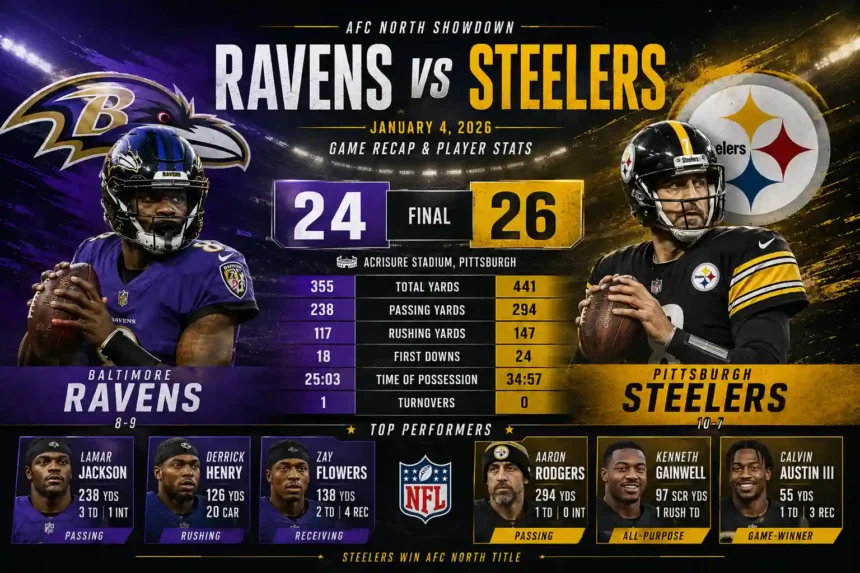
The latest Baltimore Ravens vs Pittsburgh Steelers match player stats come from Pittsburgh’s dramatic 26–24 win at Acrisure Stadium on January 4, 2026. Lamar Jackson threw for 238 yards and three touchdowns, Zay Flowers produced 138 receiving yards and two scores, and Derrick Henry rushed for 126 yards. Pittsburgh answered with 294 passing yards from Aaron Rodgers, 97 scrimmage yards from Kenneth Gainwell and a winning 26-yard touchdown catch by Calvin Austin III. Tyler Loop then missed a 44-yard field goal as time expired.
- Latest Ravens vs Steelers Result
- Baltimore Ravens vs Pittsburgh Steelers Match Player Stats at a Glance
- Lamar Jackson and Aaron Rodgers Produced Very Different Games
- Derrick Henry Controlled the Ground Game
- Zay Flowers Was Baltimore’s Most Explosive Player
- Defensive Player Stats and Game-Changing Contributions
- Special Teams Decided the Final Margin
- What the Baltimore Ravens vs Pittsburgh Steelers Match Player Stats Reveal
- Quarter-by-Quarter Turning Points
- Why Pittsburgh Won Despite Baltimore’s Bigger Plays
- Rivalry Context and 2026 Update
- Conclusion
- Frequently Asked Questions
The final kick created the lasting image, but the full statistical picture tells a more interesting story. Baltimore generated bigger plays. Pittsburgh generated more opportunities. That difference shaped the AFC North title game.
Latest Ravens vs Steelers Result
| Game detail | Information |
| Matchup | Baltimore Ravens at Pittsburgh Steelers |
| Date | January 4, 2026 |
| Venue | Acrisure Stadium, Pittsburgh |
| Final score | Steelers 26, Ravens 24 |
| Halftime score | Ravens 10, Steelers 3 |
| Baltimore record after game | 8–9 |
| Pittsburgh record after game | 10–7 |
| Main consequence | Pittsburgh won the AFC North |
| Decisive moment | Tyler Loop missed a 44-yard field goal as time expired |
The Steelers’ victory secured the division championship and ended Baltimore’s season without a playoff berth. It was the first time since the 2021 season that the Ravens failed to reach the postseason.
Baltimore Ravens vs Pittsburgh Steelers Match Player Stats at a Glance
Baltimore offensive leaders
| Player | Category | Match statistics |
| Lamar Jackson | Passing | 11/18, 238 yards, 3 TD, 1 INT |
| Lamar Jackson | Rushing | 4 carries, 9 yards |
| Derrick Henry | Rushing | 20 carries, 126 yards |
| Zay Flowers | Receiving | 4 catches, 138 yards, 2 TD |
| Devontez Walker | Receiving | 2 catches, 46 yards, 1 TD |
| Isaiah Likely | Receiving | 2 catches, 32 yards |
| Mark Andrews | Receiving | 2 catches, 14 yards |
| Tyler Loop | Kicking | 1/2 FG, 3/3 extra points |
Jackson finished with a 121.5 passer rating despite the interception. Flowers averaged 34.5 yards per reception, while Henry gained 6.3 yards per carry.
Pittsburgh offensive leaders
| Player | Category | Match statistics |
| Aaron Rodgers | Passing | 31/47, 294 yards, 1 TD, 0 INT |
| Jaylen Warren | Rushing | 14 carries, 66 yards |
| Jaylen Warren | Receiving | 5 catches, 33 yards |
| Kenneth Gainwell | Rushing | 5 carries, 10 yards, 1 TD |
| Kenneth Gainwell | Receiving | 8 catches, 64 yards |
| Calvin Austin III | Receiving | 3 catches, 55 yards, 1 TD |
| Pat Freiermuth | Receiving | 3 catches, 51 yards |
| Adam Thielen | Receiving | 3 catches, 43 yards |
| Connor Heyward | Rushing | 3 carries, 2 yards, 1 TD |
Rodgers spread his completions across eight players. Gainwell led the Steelers in receptions and receiving yards while also scoring on the ground. Austin caught only three passes, but his final reception became the game-winning touchdown.
Lamar Jackson and Aaron Rodgers Produced Very Different Games
The quarterback comparison cannot be reduced to passing yards.
Related News
Jackson was the more explosive and statistically efficient passer. He completed 61.1% of his attempts, averaged more than 13 yards per completion and threw three touchdowns. Two of those scoring passes went to Flowers from 50 and 64 yards. His other touchdown was a 38-yard strike to Devontez Walker on Baltimore’s opening possession.
Rodgers took the opposite route. Pittsburgh asked him to attempt 47 passes, more than twice Jackson’s total. He completed 31 for 294 yards, protected the football and repeatedly used shorter throws to keep the Steelers on schedule.
That approach produced only one passing touchdown, but it helped Pittsburgh record 24 first downs and hold the ball for more than 34 minutes. Rodgers’ stat line was less spectacular, yet his zero in the interception column mattered in a two-point game.
His most important throw came after Baltimore had moved ahead 24–20. Facing a defense without Kyle Hamilton, who had left with a concussion, Rodgers found Austin open for a 26-yard touchdown with one minute remaining. The scoring play gave Pittsburgh its final lead.
Quarterback comparison
| Metric | Lamar Jackson | Aaron Rodgers |
| Completions/attempts | 11/18 | 31/47 |
| Completion rate | 61.1% | 66.0% |
| Passing yards | 238 | 294 |
| Passing touchdowns | 3 | 1 |
| Interceptions | 1 | 0 |
| Passer rating | 121.5 | 90.2 |
| Rushing yards | 9 | 20 |
| Team result | Loss | Win |
Jackson created more value per throw. Rodgers created more completed plays and avoided the game’s only turnover.
Derrick Henry Controlled the Ground Game
Derrick Henry remained Baltimore’s most consistent offensive force. He rushed 20 times for 126 yards and accounted for almost 92% of the Ravens’ team rushing total.
His first carry showed Pittsburgh the challenge immediately. Henry broke outside for a 47-yard gain, although part of the play was erased by a blindside-block penalty. He continued to find space and finished with his fourth 100-yard rushing performance in five meetings against Pittsburgh as a Raven. The 126-yard game also carried historical significance because Henry passed 13,000 career rushing yards.
The problem was not Henry’s production. It was the number of opportunities available after halftime.
Pittsburgh controlled possession and limited Baltimore to 48 offensive plays. The Steelers ran 73. Baltimore therefore had fewer chances to build drives around Henry, especially after Pittsburgh began sustaining longer possessions in the third quarter.
Jaylen Warren led Pittsburgh’s ground game with 66 yards on 14 attempts. He did not score, but his 4.7 yards per carry helped keep the offense out of difficult down-and-distance situations.
Gainwell and Connor Heyward supplied the rushing touchdowns. Heyward scored from one yard on a direct snap in the third quarter, while Gainwell reached the end zone on a two-yard run in the fourth.
Zay Flowers Was Baltimore’s Most Explosive Player
Flowers delivered the outstanding receiving performance of the game.
He caught four of six targets for 138 yards and two touchdowns. His 50-yard score gave Baltimore a 17–13 fourth-quarter lead. Later, with Pittsburgh ahead 20–17, Flowers broke open for a 64-yard touchdown that restored the Ravens’ advantage with 2:20 remaining.
Those two receptions generated 114 yards. They also demonstrate why Baltimore averaged 10.6 net yards per pass attempt despite completing only 11 passes.
Devontez Walker provided another downfield threat. His 38-yard touchdown completed Baltimore’s opening 100-yard possession and established an early 7–0 lead. Walker finished with two catches for 46 yards.
Baltimore’s tight ends were quieter. Isaiah Likely caught two passes for 32 yards, while Mark Andrews recorded two catches for 14. DeAndre Hopkins received two targets but did not make a reception.
Pittsburgh won through distribution
No Pittsburgh receiver reached 65 yards, but Rodgers consistently found workable matchups.
Gainwell caught eight of nine targets for 64 yards. Warren added five receptions for 33 yards, giving Pittsburgh’s running backs 13 catches and 97 receiving yards.
Freiermuth contributed 51 yards, Adam Thielen added 43, and Marquez Valdes-Scantling made five catches for 34 yards. Austin’s three-catch, 55-yard performance included the touchdown that mattered most.
Baltimore had the dominant individual receiver. Pittsburgh had the deeper distribution pattern.
Defensive Player Stats and Game-Changing Contributions
The Steelers recorded three sacks against Jackson. Derrick Harmon, Alex Highsmith and Nick Herbig each registered one. T.J. Watt did not record a sack, but he intercepted Jackson for the only turnover of the game.
That turnover carried added weight because Baltimore had so few possessions. The Ravens averaged 7.5 yards per play, but any empty drive reduced their ability to turn explosive efficiency into points.
Pittsburgh’s defensive front also prevented Henry’s strong rushing output from becoming a series of sustained scoring drives. Baltimore finished with only 12 first downs and did not run a conventional red-zone play because its three touchdowns came from 38, 50 and 64 yards.
Baltimore produced two sacks of Rodgers. Tavius Robinson and Travis Jones received credit for one each. Kyle Hamilton, Alohi Gilman and Trenton Simpson were among the Ravens’ busiest tacklers before Hamilton left in the third quarter with a concussion. Pittsburgh’s passing attack became more productive after his departure.
Special Teams Decided the Final Margin
Both kicking units experienced critical late-game pressure.
Tyler Loop made a 40-yard field goal in the second quarter and converted all three extra points. He entered the final play with a chance to send Baltimore to the postseason, but his 44-yard attempt moved wide right as time expired.
Chris Boswell made field goals from 57 and 25 yards. His long first-half kick gave Pittsburgh its only points before halftime.
Boswell’s extra point after Austin’s touchdown was blocked, leaving the Steelers ahead by only two. That miss gave Baltimore a realistic path to victory: move into field-goal range and win 27–26.
Jackson completed the first part of that assignment. Baltimore reached Pittsburgh’s 24-yard line and centered the ball for Loop. The final kick did not convert, preserving the 26–24 score.
What the Baltimore Ravens vs Pittsburgh Steelers Match Player Stats Reveal
| Team metric | Ravens | Steelers |
| Total yards | 359 | 390 |
| Offensive plays | 48 | 73 |
| Yards per play | 7.5 | 5.3 |
| First downs | 12 | 24 |
| Rushing yards | 137 | 100 |
| Net passing yards | 222 | 290 |
| Third-down conversions | 4/12 | 9/16 |
| Fourth-down conversions | 2/2 | 1/2 |
| Turnovers | 1 | 0 |
| Penalties | 9 for 78 yards | 5 for 45 yards |
| Time of possession | 25:49 | 34:11 |
The central statistical contrast is clear: Baltimore won the explosiveness battle, while Pittsburgh won the possession battle.
Baltimore averaged 2.2 more yards per play and outrushed Pittsburgh by 37 yards. Those are usually encouraging indicators. However, the Ravens ran 25 fewer plays and possessed the ball for eight minutes and 22 seconds less.
Pittsburgh doubled Baltimore’s first-down total, 24–12. The Steelers also converted nine of 16 third downs, compared with four of 12 for the Ravens.
Those extended drives gave Rodgers more chances to find favorable matchups. They also kept Henry and Jackson on the sideline.
Penalties widened the difference. Baltimore committed nine for 78 yards, compared with five for 45 yards by Pittsburgh. The Ravens’ only turnover and final missed kick then created the two decisive statistical disadvantages in a two-point loss.
Quarter-by-Quarter Turning Points
First quarter: Baltimore strikes immediately
The Ravens opened with an eight-play touchdown drive. Henry’s early running established the threat, and Jackson finished the possession with a 38-yard touchdown pass to Walker.
Baltimore led 7–0 and appeared capable of controlling the game through its rushing attack and vertical passing.
Second quarter: Pittsburgh stays within reach
Loop’s 40-yard field goal extended the lead to 10–0. Pittsburgh finally answered through Boswell’s 57-yard kick.
The Ravens entered halftime ahead 10–3, but their advantage could have been larger. Pittsburgh’s defense had prevented another touchdown despite Baltimore’s efficiency.
Third quarter: Pittsburgh changes the game’s rhythm
The Steelers opened the second half with a 12-play, 67-yard drive that lasted more than six minutes. Connor Heyward’s one-yard direct-snap touchdown tied the score.
Boswell later added a 25-yard field goal, giving Pittsburgh its first lead at 13–10. The quarter belonged to the Steelers because they controlled the ball and reduced Baltimore’s offensive opportunities.
Fourth quarter: Four lead-changing touchdowns
Jackson found Flowers for a 50-yard score, moving Baltimore ahead 17–13.
Gainwell’s two-yard touchdown then put Pittsburgh in front 20–17.
Flowers responded with his 64-yard touchdown, restoring Baltimore’s lead at 24–20.
Rodgers answered in 80 seconds, finding Austin for the 26-yard winning score. Boswell’s blocked extra point left the final margin at two.
Baltimore reached field-goal range, but Loop’s attempt missed. The lead had changed four times in less than eight minutes.
Why Pittsburgh Won Despite Baltimore’s Bigger Plays
The Steelers created more playable downs
Pittsburgh did not need to match Baltimore’s 50- and 64-yard touchdowns on every drive. Its offense repeatedly converted manageable situations and stayed on the field.
Seventy-three offensive plays gave the Steelers more room for error than Baltimore’s 48.
Rodgers protected the football
Jackson’s three touchdowns made him the more dynamic passer, but his interception became the game’s only turnover. Rodgers attempted 29 more passes without giving Baltimore a takeaway.
Pittsburgh converted third downs
The Steelers’ 9-for-16 third-down performance was one of the game’s most important statistics. Those conversions extended possessions, produced 24 first downs and kept Baltimore’s offense inactive.
The running backs contributed in multiple roles
Warren and Gainwell combined for 76 rushing yards, 97 receiving yards and one touchdown. Their value was not concentrated in one category. They helped Rodgers handle pressure with short completions and kept Pittsburgh’s offense balanced enough to sustain drives.
Pittsburgh made the last scoring play
Flowers’ second touchdown looked capable of deciding the game. Rodgers and Austin answered immediately. In a rivalry often determined by one possession, producing the final touchdown proved more valuable than owning the most explosive individual stat line.
Rivalry Context and 2026 Update
Pittsburgh swept the two regular-season meetings in 2025. The Steelers won 27–22 in Baltimore on December 7 before taking the Week 18 rematch 26–24.
Including playoff games, Pittsburgh leads the rivalry series 38–27. The teams are scheduled to meet twice again during the 2026 season: December 20 at Acrisure Stadium and in Week 18 at M&T Bank Stadium, with the exact Week 18 date and time still to be determined as of July 30, 2026.
That scheduling detail matters for freshness. Any article discussing the “latest” player stats should continue treating the January 4 game as the most recent completed matchup until the teams play again.
Conclusion
The final score suggests that one missed kick separated Baltimore and Pittsburgh. The deeper numbers show how the game reached that moment. Jackson, Henry and Flowers gave Baltimore the better individual highlights. The Ravens averaged 7.5 yards per play and scored all three touchdowns from outside the red zone.
Pittsburgh won through volume, ball security and situational execution. Rodgers completed 31 passes without an interception, the Steelers ran 25 more plays, converted nine third downs and controlled possession for more than 34 minutes. The deciding lesson is simple: explosive plays can create leads, but sustained possessions and mistake-free football often decide close AFC North games.
Frequently Asked Questions
Who won the latest Baltimore Ravens vs Pittsburgh Steelers game?
The Pittsburgh Steelers won 26–24 on January 4, 2026, at Acrisure Stadium. The victory secured the AFC North championship for Pittsburgh and eliminated Baltimore from playoff contention.
What were Lamar Jackson’s stats against the Steelers?
Jackson completed 11 of 18 passes for 238 yards, three touchdowns and one interception. He also rushed four times for nine yards and finished with a 121.5 passer rating.
What were Aaron Rodgers’ stats against the Ravens?
Rodgers completed 31 of 47 passes for 294 yards, one touchdown and no interceptions. He also recorded a 20-yard run. His only touchdown pass was the 26-yard game-winner to Calvin Austin III.
How many rushing yards did Derrick Henry have?
Henry rushed 20 times for 126 yards, averaging 6.3 yards per carry. He did not score a touchdown, but he supplied nearly all of Baltimore’s 137 team rushing yards.
Who led the game in receiving yards?
Zay Flowers led all players with 138 receiving yards. He caught four passes and scored touchdowns from 50 and 64 yards during the fourth quarter.
Who scored the winning touchdown?
Calvin Austin III caught a 26-yard touchdown pass from Aaron Rodgers with one minute remaining. The play gave Pittsburgh a 26–24 lead.
Why did the Ravens lose despite averaging more yards per play?
Baltimore averaged 7.5 yards per play compared with Pittsburgh’s 5.3, but the Steelers ran 25 more plays, doubled the Ravens’ first-down total, controlled possession and committed no turnovers. Baltimore also missed the potential winning field goal.
When will the Ravens and Steelers play again?
Their next scheduled meeting is December 20, 2026, at Acrisure Stadium. They are also scheduled to meet in Baltimore during Week 18, with the exact kickoff date and time still listed as TBD as of July 30, 2026.