




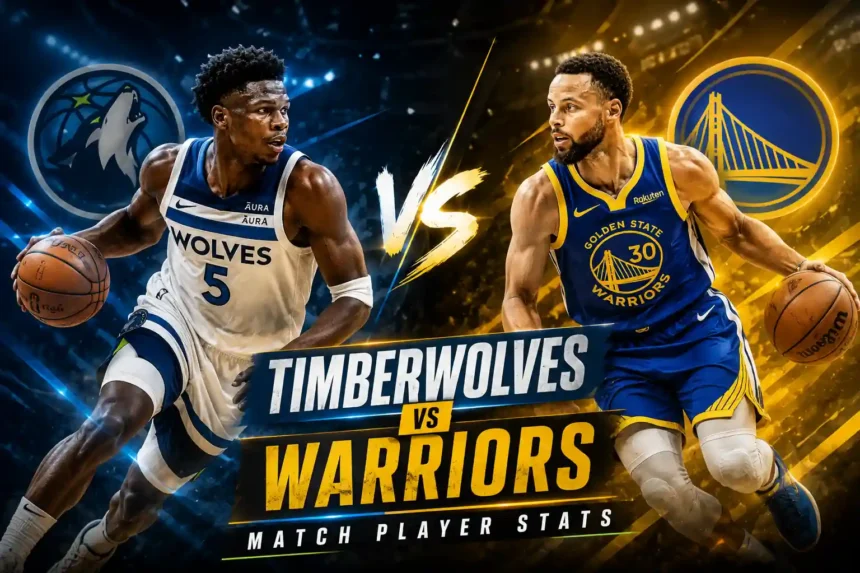
The latest Timberwolves vs Golden State Warriors match player stats show that Minnesota defeated Golden State 127–117 at Chase Center on March 13, 2026. Anthony Edwards controlled the game with 42 points, eight rebounds, and five assists. Brandin Podziemski led the Warriors with 25 points and 10 rebounds, but Minnesota’s 56.1% field-goal shooting and dominant second quarter created a lead Golden State could not erase.
- Timberwolves vs Warriors Result at a Glance
- Complete Timberwolves Player Stats
- Golden State Warriors Player Stats
- Team Stats Comparison
- How the Timberwolves Won the Game
- Quarter-by-Quarter Timeline
- How Injuries Affected Golden State
- Recent Timberwolves vs Golden State Warriors Results
- Most Important Statistical Takeaways
- Conclusion
- Frequently Asked Questions
Minnesota improved its season record against Golden State to 3–1 with the victory. The Timberwolves combined elite shot-making with balanced secondary scoring, while the Warriors struggled to convert enough of their 48 three-point attempts.
Timberwolves vs Warriors Result at a Glance
| Game detail | Information |
| Match | Minnesota Timberwolves at Golden State Warriors |
| Date | March 13, 2026 |
| Venue | Chase Center, San Francisco |
| Final score | Timberwolves 127, Warriors 117 |
| Leading scorer | Anthony Edwards, 42 points |
| Rebounding leader | Brandin Podziemski, 10 rebounds |
| Assist leader | Gui Santos, eight assists |
| Largest Minnesota lead | 25 points |
| Season-series result | Minnesota won 3–1 |
Minnesota scored at least 27 points in every quarter. Its most important stretch came before halftime, when the Timberwolves won the second quarter 38–20 and turned a three-point first-quarter advantage into a 21-point halftime lead.
Complete Timberwolves Player Stats
Anthony Edwards produced the defining individual performance, but Minnesota did not depend entirely on one scorer. Seven Timberwolves finished in double figures, giving the team enough production to survive Golden State’s second-half response.
| Minnesota player | MIN | PTS | REB | AST | FG | 3PT | FT | +/- |
| Anthony Edwards | 37 | 42 | 8 | 5 | 13–22 | 4–9 | 12–12 | +10 |
| Rudy Gobert | 36 | 18 | 9 | 2 | 5–5 | 0–0 | 8–10 | +8 |
| Jaden McDaniels | 30 | 15 | 1 | 2 | 6–9 | 1–3 | 2–2 | +7 |
| Ayo Dosunmu | 31 | 12 | 8 | 7 | 5–9 | 2–4 | 0–0 | +5 |
| Naz Reid | 27 | 12 | 3 | 4 | 5–9 | 1–1 | 1–2 | +5 |
| Bones Hyland | 11 | 11 | 1 | 1 | 4–6 | 3–5 | 0–0 | 0 |
| Julius Randle | 27 | 10 | 4 | 1 | 5–11 | 0–2 | 0–0 | +9 |
| Donte DiVincenzo | 28 | 7 | 6 | 1 | 3–9 | 1–6 | 0–0 | +11 |
| Kyle Anderson | 15 | 0 | 5 | 2 | 0–2 | 0–0 | 0–0 | -5 |
Statistics are based on the official game box score. Totals can differ slightly between publishers when playing time is rounded to whole minutes.
Anthony Edwards’ 42-Point Performance
Edwards scored 42 points on only 22 field-goal attempts. He made 13 shots from the floor, four three-pointers and all 12 of his free throws.
Related News
His efficiency was as important as his scoring total. Edwards recorded an effective field-goal percentage of approximately 68.2%, combining strong interior finishing with accurate perimeter shooting. He also added eight rebounds, five assists, one steal and one block.
Golden State could not consistently keep him away from the paint or the foul line. When defenders gave him space, he converted pull-up shots. When they played closer, he attacked gaps and created contact.
Edwards committed only two turnovers despite carrying Minnesota’s largest offensive workload. That balance between aggression and control prevented the Warriors from turning his high usage into transition opportunities.
Rudy Gobert’s Interior Efficiency
Gobert delivered 18 points and nine rebounds while making all five of his field-goal attempts. He also converted eight of 10 free throws, an especially valuable return for a center whose free-throw shooting can sometimes be targeted by opponents.
His screens, rim runs and interior presence helped Minnesota score 52 points in the paint. Golden State finished with 40 paint points despite attempting 15 more shots overall.
Gobert’s impact was not limited to blocks. His positioning discouraged direct drives and forced the Warriors to depend heavily on perimeter attempts. Golden State took 48 three-pointers, nearly half of its total field-goal attempts.
Minnesota’s Secondary Playmakers
Ayo Dosunmu nearly recorded a triple-double off the bench, finishing with 12 points, eight rebounds and seven assists. His seven assists were the most by any Minnesota player.
Dosunmu gave the Timberwolves an additional ball handler who could organize possessions when Edwards rested or faced extra defensive attention. He shot 5-for-9 from the field and made two of his four three-point attempts.
Naz Reid added 12 points and four assists without committing a turnover. Bones Hyland supplied 11 points in fewer than 11 minutes, including three three-pointers.
Those contributions made it difficult for Golden State to recover when Minnesota moved away from its starting lineup. The Timberwolves received 35 bench points and had multiple reserves capable of scoring or creating shots.
Golden State Warriors Player Stats
Brandin Podziemski, Kristaps Porziņģis and Gui Santos carried most of Golden State’s offensive production. The Warriors received contributions from several players, but they could not match Minnesota’s shooting efficiency.
| Golden State player | MIN | PTS | REB | AST | FG | 3PT | FT | +/- |
| Brandin Podziemski | 36 | 25 | 10 | 2 | 8–17 | 5–10 | 4–5 | -6 |
| Kristaps Porziņģis | 22 | 20 | 4 | 2 | 7–16 | 2–5 | 4–4 | -8 |
| Gui Santos | 35 | 17 | 3 | 8 | 6–15 | 3–10 | 2–2 | -3 |
| De’Anthony Melton | 24 | 12 | 2 | 3 | 4–11 | 2–5 | 2–2 | 0 |
| Gary Payton II | 19 | 12 | 3 | 2 | 4–8 | 0–1 | 4–4 | -5 |
| LJ Cryer | 19 | 8 | 2 | 0 | 2–6 | 0–4 | 4–4 | -3 |
| Pat Spencer | 19 | 7 | 2 | 3 | 3–6 | 1–3 | 0–0 | -18 |
| Quinten Post | 11 | 7 | 3 | 1 | 2–4 | 1–2 | 2–2 | -7 |
| Malevy Leons | 14 | 6 | 2 | 1 | 2–6 | 0–2 | 2–2 | +7 |
| Al Horford | 5 | 3 | 1 | 0 | 1–3 | 1–3 | 0–0 | -3 |
| Seth Curry | 7 | 0 | 1 | 1 | 0–2 | 0–0 | 0–0 | -5 |
| Will Richard | 29 | 0 | 5 | 0 | 0–3 | 0–3 | 0–0 | +1 |
Official box-score sources report that Draymond Green did not play because of lower-back injury management.
Brandin Podziemski’s Double-Double
Podziemski gave Golden State its most complete performance. He recorded:
- 25 points
- 10 rebounds
- Five three-pointers
- Two assists
- Zero turnovers
He shot 8-for-17 overall and 5-for-10 from three-point range. His outside shooting helped the Warriors reduce a deficit that had reached 25 points.
His 10 rebounds were also a team high. Three came on the offensive glass, creating additional possessions for a Golden State team that needed every available scoring opportunity.
Podziemski’s zero turnovers stood out because he played 36 minutes and handled a meaningful share of the offense. However, his individual efficiency could not overcome Minnesota’s collective 56.1% field-goal percentage.
Kristaps Porziņģis’ First Start
Porziņģis moved into the starting lineup and scored 20 points in 22 minutes. He shot 7-for-16 from the field, 2-for-5 from three and 4-for-4 from the foul line.
His combination of size and shooting gave Golden State a floor-spacing option against Gobert. He also registered two steals and one block.
The main limitation was availability. Porziņģis played just over 22 minutes, and the Warriors were outscored by eight points during that time. Golden State needed more sustained two-way production after falling behind so heavily in the second quarter.
Gui Santos as a Playmaker
Santos finished with 17 points and a game-high eight assists. His passing helped Golden State maintain ball movement despite missing several established creators.
He also made three three-pointers, although he needed 10 attempts from behind the arc. His overall 6-for-15 shooting line reflected the broader Warriors problem: useful offensive activity without enough efficient conversion.
Team Stats Comparison
| Statistical category | Timberwolves | Warriors |
| Points | 127 | 117 |
| Field goals | 46–82 | 39–97 |
| Field-goal percentage | 56.1% | 40.2% |
| Three-pointers | 12–30 | 15–48 |
| Three-point percentage | 40.0% | 31.3% |
| Free throws | 23–26 | 24–25 |
| Free-throw percentage | 88.5% | 96.0% |
| Rebounds | 45 | 38 |
| Assists | 25 | 23 |
| Turnovers | 16 | 8 |
| Steals | 6 | 8 |
| Blocks | 5 | 1 |
| Points in the paint | 52 | 40 |
| Bench points | 35 | 40 |
The most important difference was shooting efficiency. Minnesota made seven more field goals despite attempting 15 fewer shots. Golden State protected the ball better and generated more attempts, but its additional volume did not compensate for a 15.9-percentage-point disadvantage in overall shooting.
Why Minnesota’s Shooting Advantage Mattered
Minnesota scored approximately 1.55 points for every made field goal, before accounting for free throws. The Timberwolves created efficient attempts around the rim while also shooting 40% from three.
Golden State made three more three-pointers, but it required 18 additional attempts to do so. The Warriors scored 45 points from beyond the arc compared with Minnesota’s 36, yet Minnesota recovered that difference through two-point efficiency and paint scoring.
The Timberwolves made 34 two-point field goals. Golden State made only 24. That 20-point advantage from inside the arc explains much of the final margin.
Rebounding and Interior Control
Minnesota won the total rebounding battle 45–38. Gobert and Edwards combined for 17 rebounds, while Dosunmu added eight from the bench.
Golden State collected 14 offensive rebounds compared with Minnesota’s 11, but the Warriors did not consistently turn those extra opportunities into efficient points.
Minnesota’s advantage came from finishing defensive possessions and converting the following possession at a much higher rate.
Golden State Won the Turnover Battle
The Warriors committed only eight turnovers, half Minnesota’s total. They also recorded eight steals and produced 13 points off turnovers.
Normally, that type of possession advantage would provide a strong route to victory. In this game, however, Golden State’s missed shots neutralized the benefit.
The Warriors attempted 97 field goals but made only 39. Minnesota attempted 82 and made 46. The contrast demonstrates why possession volume must be evaluated alongside shot quality and conversion.
How the Timberwolves Won the Game
1. Edwards Created Efficient High-Volume Offense
Edwards accounted for one-third of Minnesota’s points while shooting 59.1% from the field. He was perfect at the line and productive from three-point range.
Golden State never found a defensive coverage that could consistently slow all three parts of his scoring game.
2. Minnesota Dominated the Second Quarter
The Timberwolves led 31–28 after the opening period. They then outscored Golden State 38–20 in the second quarter.
A 17–4 Minnesota run helped turn a competitive game into a large advantage. By halftime, the Timberwolves led 69–48.
The Warriors improved after halftime and won both the third and fourth quarters, but the damage had already been done. Golden State would have needed to win the second half by more than 21 points to complete the comeback.
3. Seven Players Reached Double Figures
Edwards was the star, but the Timberwolves also received double-digit scoring from Gobert, McDaniels, Randle, Dosunmu, Reid and Hyland.
That balance prevented the Warriors from solving the game simply by sending additional defenders toward Edwards.
4. Minnesota Controlled the Paint
Minnesota won the paint-scoring battle 52–40. Gobert’s perfect shooting, Edwards’ rim pressure and the team’s interior passing produced efficient opportunities.
Golden State frequently settled for three-point attempts. The Warriors made 15, but their 31.3% accuracy was not enough to keep pace with Minnesota.
Quarter-by-Quarter Timeline
| Quarter | Minnesota | Golden State | Game development |
| First | 31 | 28 | Competitive opening with Minnesota holding a narrow lead |
| Second | 38 | 20 | Timberwolves take control with their decisive scoring run |
| Third | 31 | 39 | Warriors improve their shooting and begin a comeback |
| Fourth | 27 | 30 | Golden State reduces the margin but cannot erase the deficit |
| Final | 127 | 117 | Minnesota completes a 10-point road victory |
Golden State briefly cut Minnesota’s lead to seven points in the fourth quarter. The Timberwolves responded before the Warriors could turn the rally into a one-possession game.
How Injuries Affected Golden State
The Warriors entered and completed the game with a depleted rotation.
Stephen Curry missed his 16th consecutive game, while Draymond Green was removed from the lineup shortly before tipoff because of a lower-back issue. Jimmy Butler was also unavailable while recovering from knee surgery. During the game, Al Horford left with calf tightness and Seth Curry exited with thigh tightness.
These absences do not erase Minnesota’s performance, but they help explain Golden State’s unusual starting lineup and its reliance on Podziemski, Santos and Porziņģis.
The Warriors still produced 117 points and committed only eight turnovers. Their larger problem was stopping Minnesota, particularly before halftime.
Recent Timberwolves vs Golden State Warriors Results
The broad keyword can refer to more than one meeting. The teams played four regular-season games during the 2025–26 season, with Minnesota winning three.
| Date | Winner | Score |
| December 12, 2025 | Minnesota Timberwolves | 127–120 |
| January 25, 2026 | Golden State Warriors | 111–85 |
| January 26, 2026 | Minnesota Timberwolves | 108–83 |
| March 13, 2026 | Minnesota Timberwolves | 127–117 |
Official NBA results confirm the four scores, while the March victory completed Minnesota’s 3–1 season-series advantage.
The results also show considerable variation. Two meetings were decided by at least 25 points, while the December and March games produced higher-scoring, more competitive finishes.
Most Important Statistical Takeaways
Best overall performance: Anthony Edwards delivered the game’s highest scoring total and combined it with strong efficiency, rebounding and playmaking.
Best Warriors performance: Brandin Podziemski recorded a 25-point, 10-rebound double-double without committing a turnover.
Most decisive team statistic: Minnesota’s 56.1% field-goal shooting was significantly better than Golden State’s 40.2%.
Most important period: Minnesota’s 38–20 second quarter created the separation that determined the game.
Best supporting performance: Ayo Dosunmu contributed 12 points, eight rebounds and seven assists from the bench.
Key tactical difference: Minnesota scored efficiently inside the arc, while Golden State depended heavily on three-point volume.
Conclusion
The Timberwolves vs Golden State Warriors match player stats reveal a game decided by efficiency rather than shot volume. Golden State protected the ball and generated 15 more field-goal attempts, but Minnesota converted its opportunities at a far higher rate. Anthony Edwards supplied the headline performance with 42 points, while Rudy Gobert, Ayo Dosunmu and Minnesota’s other double-digit scorers provided the balance needed to protect the lead.
For Golden State, Brandin Podziemski’s double-double and Kristaps Porziņģis’ 20 points were encouraging individual results. However, the Warriors’ 40.2% shooting and damaging second quarter left them with too much ground to recover. Minnesota’s 127–117 victory therefore reflected more than one star’s scoring output. It was the result of efficient offense, paint control, balanced production, and one dominant quarter.
Frequently Asked Questions
Who won the latest Timberwolves vs Warriors game?
The Minnesota Timberwolves defeated the Golden State Warriors 127–117 at Chase Center on March 13, 2026. It was Minnesota’s third win in four regular-season meetings against Golden State that season.
Who scored the most points?
Anthony Edwards led all players with 42 points. He shot 13-for-22 from the field, 4-for-9 from three-point range and 12-for-12 at the free-throw line.
What were Anthony Edwards’ complete stats?
Edwards finished with 42 points, eight rebounds, five assists, one steal, one block and two turnovers in approximately 37 minutes. He posted a plus-10 rating.
Who was Golden State’s leading scorer?
Brandin Podziemski led the Warriors with 25 points. He also recorded 10 rebounds, two assists and five three-pointers while committing no turnovers.
Which team shot better?
Minnesota shot 56.1% from the field and 40% from three. Golden State shot 40.2% overall and 31.3% from beyond the arc. Minnesota’s superior two-point efficiency was particularly important.
Why did the Warriors lose despite committing fewer turnovers?
Golden State committed only eight turnovers compared with Minnesota’s 16, but the Warriors made seven fewer field goals despite taking 15 more attempts. Their poor shooting percentage outweighed their possession advantage.
Did Stephen Curry play?
No. Stephen Curry missed the game and was unavailable for the 16th consecutive contest. Golden State was also without Draymond Green and Jimmy Butler.
What quarter decided the game?
The second quarter was decisive. Minnesota outscored Golden State 38–20 and entered halftime with a 69–48 lead.