



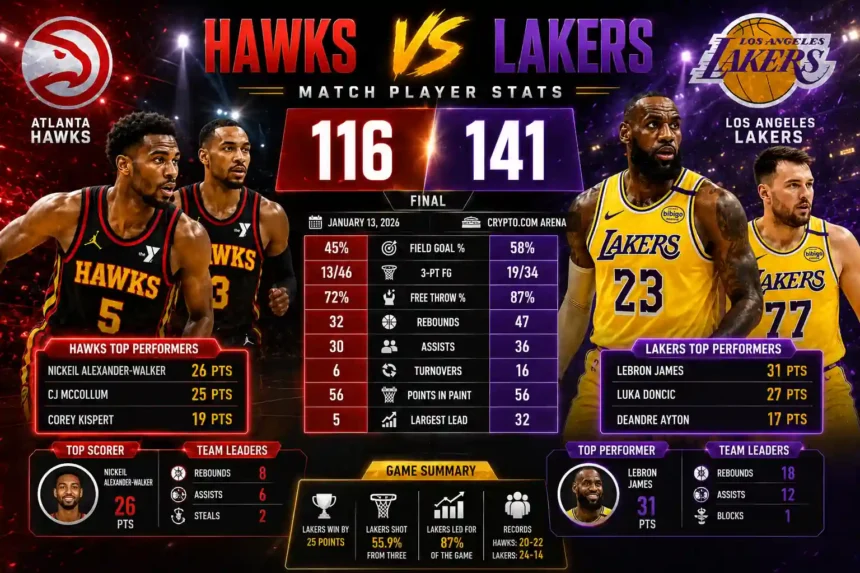
The Los Angeles Lakers defeated the Atlanta Hawks 141-116 on January 13, 2026, at Crypto.com Arena. LeBron James led Los Angeles with 31 points, 10 assists and nine rebounds, while Luka Dončić added 27 points and 12 assists. Nickeil Alexander-Walker scored 26 points for Atlanta, and CJ McCollum contributed 25. The decisive difference was shooting: Los Angeles made 57.8% of its field goals and 55.9% of its three-pointers.
- Latest Hawks vs Lakers Result at a Glance
- Atlanta Hawks vs Lakers Match Player Stats
- Hawks vs Lakers Team Stats Comparison
- How the Game Developed Quarter by Quarter
- Why the Lakers Won by 25 Points
- Lakers Player Performance Analysis
- Atlanta Hawks Player Performance Analysis
- How This Game Reversed the Previous Meeting
- Biggest Statistical Takeaways
- Conclusion
- Frequently Asked Questions
Latest Hawks vs Lakers Result at a Glance
| Game detail | Information |
| Matchup | Atlanta Hawks at Los Angeles Lakers |
| Date | January 13, 2026 |
| Venue | Crypto.com Arena, Los Angeles |
| Final score | Lakers 141, Hawks 116 |
| Halftime score | Lakers 81, Hawks 60 |
| Lakers top scorer | LeBron James — 31 points |
| Hawks top scorer | Nickeil Alexander-Walker — 26 points |
| Rebounding leader | Deandre Ayton — 18 rebounds |
| Assist leader | Luka Dončić — 12 assists |
| Largest lead | Lakers — 32 points |
| Season-series result | Tied 1-1 |
The Lakers improved to 24-14 with the victory, while Atlanta fell to 20-22. Los Angeles led for approximately 87% of the game and controlled all but a brief stretch of the opening quarter.
Atlanta Hawks vs Lakers Match Player Stats
The following tables contain the major box-score numbers for every player who entered the game. Minutes are rounded to the nearest whole minute for easier reading.
Los Angeles Lakers Player Stats
| Player | MIN | PTS | REB | AST | STL | BLK | FG | 3PT | FT |
| LeBron James | 33 | 31 | 9 | 10 | 1 | 1 | 12-20 | 2-4 | 5-6 |
| Luka Dončić | 33 | 27 | 5 | 12 | 0 | 1 | 7-16 | 5-9 | 8-10 |
| Deandre Ayton | 31 | 17 | 18 | 1 | 0 | 0 | 7-9 | 0-0 | 3-3 |
| Jake LaRavia | 36 | 17 | 4 | 3 | 1 | 0 | 6-10 | 3-4 | 2-2 |
| Marcus Smart | 29 | 16 | 5 | 4 | 0 | 1 | 4-5 | 2-3 | 6-6 |
| Gabe Vincent | 14 | 10 | 1 | 1 | 0 | 0 | 3-6 | 3-5 | 1-1 |
| Rui Hachimura | 18 | 7 | 2 | 0 | 0 | 0 | 3-7 | 1-3 | 0-0 |
| Nick Smith Jr. | 4 | 6 | 0 | 2 | 0 | 0 | 2-2 | 2-2 | 0-0 |
| Jarred Vanderbilt | 16 | 3 | 1 | 1 | 0 | 0 | 1-2 | 0-1 | 1-2 |
| Kobe Bufkin | 4 | 3 | 1 | 1 | 0 | 0 | 1-1 | 1-1 | 0-0 |
| Dalton Knecht | 15 | 2 | 0 | 0 | 0 | 0 | 1-3 | 0-2 | 0-0 |
| Drew Timme | 4 | 2 | 1 | 0 | 0 | 0 | 1-1 | 0-0 | 0-0 |
| Bronny James | 4 | 0 | 0 | 1 | 0 | 0 | 0-1 | 0-0 | 0-0 |
Los Angeles received at least 16 points from all five starters. Together, the starting lineup produced 108 of the Lakers’ 141 points, 41 rebounds and 30 assists.
Atlanta Hawks Player Stats
| Player | MIN | PTS | REB | AST | STL | BLK | FG | 3PT | FT |
| Nickeil Alexander-Walker | 33 | 26 | 4 | 3 | 0 | 0 | 10-16 | 5-9 | 1-1 |
| CJ McCollum | 27 | 25 | 1 | 3 | 1 | 0 | 11-23 | 2-8 | 1-3 |
| Corey Kispert | 26 | 19 | 0 | 1 | 0 | 0 | 6-11 | 3-7 | 4-6 |
| Jalen Johnson | 30 | 13 | 3 | 6 | 1 | 0 | 5-17 | 1-7 | 2-2 |
| Vit Krejčí | 21 | 11 | 2 | 4 | 1 | 0 | 4-11 | 1-7 | 2-2 |
| Dyson Daniels | 33 | 8 | 8 | 5 | 2 | 0 | 4-6 | 0-0 | 0-0 |
| Onyeka Okongwu | 33 | 7 | 8 | 4 | 0 | 1 | 3-8 | 0-3 | 1-2 |
| Mouhamed Gueye | 22 | 5 | 4 | 1 | 5 | 0 | 1-4 | 1-2 | 2-2 |
| Keaton Wallace | 4 | 2 | 1 | 1 | 0 | 0 | 1-3 | 0-2 | 0-0 |
| Asa Newell | 10 | 0 | 1 | 2 | 1 | 0 | 0-1 | 0-1 | 0-0 |
Alexander-Walker was Atlanta’s most efficient high-volume scorer. He made 10 of 16 field-goal attempts and five of nine three-pointers. McCollum added 25 points, but he needed 23 shots and made only two of eight attempts from long range.
Hawks vs Lakers Team Stats Comparison
| Team statistic | Atlanta Hawks | Los Angeles Lakers |
| Points | 116 | 141 |
| Field goals | 45-100 | 48-83 |
| Field-goal percentage | 45.0% | 57.8% |
| Three-pointers | 13-46 | 19-34 |
| Three-point percentage | 28.3% | 55.9% |
| Free throws | 13-18 | 26-30 |
| Free-throw percentage | 72.2% | 86.7% |
| Total rebounds | 32 | 47 |
| Offensive rebounds | 12 | 10 |
| Defensive rebounds | 20 | 37 |
| Assists | 30 | 36 |
| Steals | 11 | 2 |
| Blocks | 1 | 3 |
| Team turnovers | 6 | 16 |
| Fast-break points | 16 | 23 |
| Points in the paint | 56 | 56 |
| Largest lead | 5 | 32 |
Los Angeles shot 12.8 percentage points better from the field and 27.6 percentage points better from three-point range. It also collected 15 more rebounds and attempted 12 more free throws. Atlanta protected the ball and forced steals, but those advantages were not enough to overcome the Lakers’ shooting.
Related News
How the Game Developed Quarter by Quarter
First quarter: Los Angeles establishes its rhythm
Atlanta made a positive start behind Alexander-Walker, who converted a four-point play and quickly reached nine points. The Lakers answered through Ayton, James and Dončić before a 10-0 run moved the home team ahead.
Los Angeles also received immediate perimeter production from its supporting cast. Vincent made three early three-pointers, helping the Lakers finish the first quarter with a 37-30 lead.
Second quarter: The Lakers take control
The second period decided the direction of the game. Los Angeles scored 44 points while shooting efficiently from nearly every area of the floor.
Dončić scored 23 of his 27 points before halftime and made five of six first-half three-point attempts. LaRavia reached 13 points, while every Lakers starter moved into double figures shortly afterward.
Los Angeles entered halftime leading 81-60. The 81 points represented its highest-scoring half of the season at that stage.
Third quarter: Atlanta avoids an early finish
The Lakers pushed their advantage to 32 points after halftime. Ayton scored around the basket, and Los Angeles continued to create efficient opportunities through James and Dončić.
Atlanta then produced its best defensive stretch. The Hawks forced Los Angeles into rushed possessions and scored 10 unanswered points during a three-minute Lakers drought.
Atlanta won the third quarter 26-21, reducing the deficit to 16 entering the fourth.
Fourth quarter: LeBron closes the door
The Hawks continued their run and cut the margin to 11. At that stage, the game briefly appeared competitive again.
James responded with a key jump shot and later connected from the corner. Los Angeles then produced separate 8-0 and 11-point runs to restore a comfortable advantage.
Both teams removed their main players with 3:45 remaining, and the Lakers completed the 141-116 win.
Why the Lakers Won by 25 Points
1. Exceptional three-point shooting
The clearest difference was perimeter efficiency.
Los Angeles made 19 of 34 three-pointers, equal to 55.9%. Atlanta attempted 12 more threes but made only 13 of 46, or 28.3%.
The six-shot difference in made three-pointers gave Los Angeles an 18-point advantage from behind the arc. It was especially damaging because Atlanta repeatedly failed to convert open or recoverable possessions at the other end.
The Lakers did not depend on one shooter. Dončić made five threes, LaRavia and Vincent made three each, while James, Smart and Smith added two apiece.
That distribution made defensive adjustments difficult. Helping against James or Dončić often created an open opportunity for another player.
2. LeBron and Luka combined scoring with playmaking
James and Dončić combined for:
- 58 points
- 22 assists
- 14 rebounds
- Seven made three-pointers
James finished one rebound short of a triple-double. Dončić completed a points-and-assists double-double despite committing seven turnovers.
Their 22 combined assists were particularly significant. Atlanta recorded 30 assists as an entire team, meaning the Lakers’ two main creators produced almost three-quarters of that total by themselves.
Both players attracted multiple defenders, and the supporting lineup consistently converted the resulting chances.
3. Deandre Ayton controlled the glass
Ayton’s 17 points were valuable, but his 18 rebounds may have been even more influential.
He collected 15 defensive rebounds, helping Los Angeles finish possessions without giving Atlanta repeated opportunities. The Hawks secured 12 offensive boards, but the Lakers still dominated the total rebounding count 47-32.
Ayton also made seven of nine field-goal attempts. His efficient interior scoring forced Atlanta to protect the rim while James and Dončić were creating shots on the perimeter.
4. The entire starting lineup contributed
Many NBA games are decided by one star performance. This result was different because all five Lakers starters were productive.
| Lakers starter | Points |
| LeBron James | 31 |
| Luka Dončić | 27 |
| Deandre Ayton | 17 |
| Jake LaRavia | 17 |
| Marcus Smart | 16 |
| Starter total | 108 |
Atlanta’s starters scored 65 points. Its bench outscored the Lakers’ reserves 51-33, but that 18-point bench advantage could not erase the 43-point difference between the starting units.
5. Los Angeles created a major free-throw advantage
The Lakers made 26 free throws, twice Atlanta’s total of 13.
Los Angeles scored 13 more points at the line and 18 more points from three-point shots. Atlanta made six more points from two-point field goals, but the combined three-point and free-throw gaps still created the final 25-point margin.
Smart was perfect on six free throws, while Dončić went 8-for-10 and James made five of six.
6. Shooting overcame the turnover problem
The unusual part of this game was that Atlanta committed only six turnovers and recorded 11 steals. Los Angeles had 16 team turnovers and only two steals.
Those figures would normally favor the Hawks. However, turnovers are only damaging when the opponent converts the additional possessions efficiently.
Atlanta attempted 100 field goals but made 45. Los Angeles needed only 83 attempts to make 48. The Lakers therefore made more shots despite attempting 17 fewer.
That contrast explains the result better than the turnover count alone.
Lakers Player Performance Analysis
LeBron James: the complete performance
James produced the strongest all-around line of the game:
31 points, nine rebounds, 10 assists, one steal and one block.
He shot 60% from the field and 50% from three. His ability to score without dominating every possession allowed Dončić to control stretches of the first half.
James also played an important role in stopping Atlanta’s fourth-quarter momentum. When the lead fell to 11, he helped restart the Lakers’ offense and remove the possibility of a complete comeback.
Luka Dončić: first-half offensive control
Dončić scored 23 points before halftime and ended with 27 points, 12 assists and five rebounds.
His five made three-pointers stretched Atlanta’s defense well beyond the arc. When defenders stepped forward, Dončić found Ayton near the basket or passed to open shooters.
The main negative was his seven turnovers. Several came during Atlanta’s third-quarter run, when the Lakers temporarily lost their offensive structure. Still, his +27 plus-minus reflected Los Angeles’ control during his minutes.
Deandre Ayton: efficient interior production
Ayton’s 17-point, 18-rebound performance gave Los Angeles balance.
He did not require a large number of touches, making seven of nine field-goal attempts. His 77.8% shooting was the best mark among the Lakers’ regular rotation players.
The Hawks could not leave him unattended near the rim, which created additional space for the Lakers’ ball handlers.
Jake LaRavia and Marcus Smart: ideal supporting contributions
LaRavia scored 17 points on 6-for-10 shooting and made three of four three-pointers. He added four rebounds and three assists without disrupting the rhythm of the main creators.
Smart produced 16 points on only five field-goal attempts. He made four shots, reached the line six times and posted a game-high +32 plus-minus.
Together, LaRavia and Smart provided 33 points from eight made field goals and eight free throws. Their efficiency prevented Atlanta from loading its defense entirely toward James and Dončić.
Atlanta Hawks Player Performance Analysis
Nickeil Alexander-Walker: Atlanta’s best scorer
Alexander-Walker finished with 26 points on 10-for-16 shooting.
He was Atlanta’s only high-volume player to remain consistently efficient from outside, making five of nine three-pointers. His early scoring kept the Hawks competitive, and his perimeter shooting supported their second-half response.
His minus-37 rating shows how strongly the Lakers controlled the game while he was on the floor, but that number should not be treated as an individual failure. Much of it resulted from Los Angeles’ collective shooting performance.
CJ McCollum: productive but less efficient
McCollum scored 25 points and made 11 field goals. However, his two-for-eight three-point shooting limited the value of that production.
He was effective from mid-range and during Atlanta’s second-quarter attempts to stay close. The Hawks needed more perimeter efficiency from him once the Lakers began scoring at a rapid rate.
Jalen Johnson: difficult shooting night
Johnson finished with 13 points, six assists and three rebounds. He avoided turnovers and continued creating for teammates, but his scoring efficiency was below his usual standard.
He made five of 17 field goals and one of seven three-pointers. His 29.4% shooting made it difficult for Atlanta to punish the Lakers when they focused defensive attention on Alexander-Walker and McCollum.
Dyson Daniels: useful work beyond scoring
Daniels contributed eight points, eight rebounds, five assists and two steals.
He made four of six shots and committed no turnovers. Five of his eight rebounds came on the offensive glass, giving Atlanta extra possessions.
His low shot volume, however, meant the Lakers could focus more attention on Atlanta’s primary scorers.
Atlanta’s bench provided real production
The Hawks’ reserves scored 51 points. McCollum, Kispert and Gueye combined for 49 of those points.
Kispert was particularly effective, scoring 19 points in 26 minutes while making three three-pointers. Gueye recorded five points, four rebounds and five steals.
The bench performance was one of Atlanta’s few clear advantages. The problem was that the Lakers’ starters had already created too large a deficit.
How This Game Reversed the Previous Meeting
The teams split their 2025-26 regular-season series.
Atlanta won the first game 122-102 on November 8, 2025. Mouhamed Gueye recorded a career-high 21 points with seven rebounds and seven assists. Dyson Daniels added 10 points, eight rebounds and 13 assists, while Atlanta had seven players score in double figures.
Luka Dončić scored 22 points with 11 assists and five rebounds in that first meeting, but all 22 points came before halftime. Atlanta forced the Lakers into 20 turnovers and generated 37 assists on 48 made field goals.
The second game produced almost the opposite pattern.
| Category | Nov. 8, 2025 | Jan. 13, 2026 |
| Winner | Atlanta Hawks | Los Angeles Lakers |
| Score | Hawks 122-102 | Lakers 141-116 |
| Winning margin | Atlanta by 20 | Los Angeles by 25 |
| Main story | Atlanta depth and forced turnovers | Lakers shooting and starter production |
| Key scorer | Mouhamed Gueye — 21 | LeBron James — 31 |
| Key creator | Dyson Daniels — 13 assists | Luka Dončić — 12 assists |
| Losing-team issue | Lakers committed 20 turnovers | Hawks shot 28.3% from three |
Atlanta controlled the first meeting with defense, passing and balanced scoring. Los Angeles controlled the rematch with shooting, rebounding and star-led creation.
The two results demonstrate how quickly the same matchup can change when availability, shot-making and turnover pressure move in different directions.
Biggest Statistical Takeaways
Los Angeles produced elite offensive efficiency
The Lakers recorded an estimated effective field-goal percentage of 69.3%. That figure rewards made three-pointers more heavily than ordinary field-goal percentage because they produce an additional point.
Atlanta’s effective field-goal percentage was 51.5%. The gap shows that the Lakers did not merely make more shots; they generated much greater value from each attempt.
Atlanta’s possession advantage was wasted
The Hawks attempted 17 more field goals and committed 10 fewer team turnovers.
That should have given them a path into the game. Instead, poor three-point accuracy prevented them from using those extra attempts effectively.
The paint was not the main difference
Both teams scored 56 points in the paint.
This means the Lakers’ advantage did not come from simply overpowering Atlanta near the basket. The result was created through outside shooting, free throws, defensive rebounding and overall efficiency.
Los Angeles received production from every level
The Lakers had:
- Two stars controlling scoring and passing
- A center controlling the defensive glass
- Two efficient supporting starters
- Bench shooters converting open opportunities
That balance made the offense difficult to stop. Atlanta could defend one action correctly and still concede a high-quality shot elsewhere.
Conclusion
The Atlanta Hawks vs Lakers match player stats show that Los Angeles won through efficiency rather than additional possessions. Atlanta committed fewer turnovers, collected more steals and attempted 17 more field goals. Those advantages would normally support a competitive result. However, the Hawks made only 28.3% of their threes and collected just 20 defensive rebounds.
The Lakers punished those weaknesses. James delivered 31 points and 10 assists. Dončić added 27 points and 12 assists. Ayton controlled the glass with 18 rebounds, while LaRavia and Smart supplied 33 efficient points. Los Angeles made six more three-pointers and 13 more free throws. Its starting lineup outscored Atlanta’s starters 108-65 and built a lead that reached 32 points.
Atlanta’s third-quarter response showed resilience, but the Lakers still had too much shot creation and shooting depth. The final box score tells a clear story: possession volume helped the Hawks create opportunities, but Los Angeles turned its opportunities into points at a far higher rate.
Frequently Asked Questions
Who won the latest Atlanta Hawks vs Lakers game?
The Los Angeles Lakers won 141-116 on January 13, 2026. It was the teams’ second and final regular-season meeting of the 2025-26 campaign, leaving the season series tied 1-1.
Who was the leading scorer in the Hawks–Lakers matchup?
LeBron James led all players with 31 points. He made 12 of 20 field goals, two of four three-pointers and five of six free throws.
What were LeBron James’ stats against Atlanta?
James recorded 31 points, 10 assists, nine rebounds, one steal and one block in approximately 33 minutes. He finished one rebound short of a triple-double.
What were Luka Dončić’s stats against the Hawks?
Dončić finished with 27 points, 12 assists, five rebounds and one block. He made five three-pointers but also committed seven turnovers.
Who scored the most points for Atlanta?
Nickeil Alexander-Walker led the Hawks with 26 points. He shot 10-for-16 overall and 5-for-9 from three-point range.
Who had the most rebounds in the game?
Deandre Ayton led both teams with 18 rebounds. Fifteen were defensive rebounds and three came on the offensive glass.
How did the Lakers win despite committing more turnovers?
Los Angeles overcame its turnover disadvantage through exceptional shooting. The Lakers made 57.8% of their field goals and 55.9% of their three-pointers, while Atlanta shot 45% overall and 28.3% from long range.
What was the result of the 2025-26 Hawks–Lakers season series?
The season series finished 1-1. Atlanta won the November 8, 2025 game 122-102, and Los Angeles won the January 13, 2026 rematch 141-116.